factograf
EN
Sign in

11th Sultan of the Ottoman Empire (1566–1574)

Selim II

Selim II

Selim II (1524–1574), also known as Selim the Blond or Selim the Drunkard, was the Ottoman sultan from 1566 until his death in 1574. He was the son of Suleiman the Magnificent and Hürrem Sultan. During his reign, Grand Vizier Sokollu Mehmed Pasha held considerable control over state governance. The conquest of Cyprus and Tunis were notable achievements, while setbacks included the defeat at the Battle of Lepanto and the failed capture of Astrakhan during the war with Russia.

Early life

Paolo Veronese's portrait of Sultan Selim II, held by the Bavarian State Painting Collections.
Equestrian portrait of Prince Selim riding between Kotahia and Belgrade to rejoin the Imperial Army in early 1566, during the Siege of Szigetvár. His father would die, and Selim would become Sultan Selim II later that year. Nüzhet (TSMK H.1339, 1569).
Sultan Selim writing a letter in 1566. Nüzhet (1568–69).
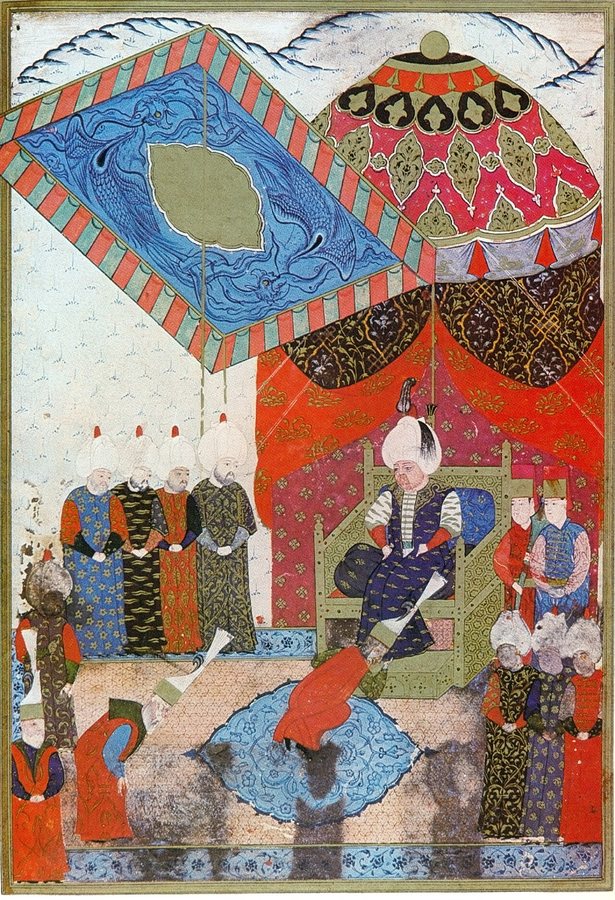
Selim ascends the throne. Nüzhet-i Esrâr (1568–69).
Presentation of gifts by the Safavid ambassador, Shahquili, to Sultan Selim II at Edirne in 1568, from the Şehname-i Selim Han, 1581.
5 images

Selim was born in the Topkapı Palace in Constantinople, the second surviving son of Suleiman the Magnificent and Hürrem Sultan, who had been a concubine before becoming Suleiman's legal wife. As a prince he received provincial governorships, first at Karaman and later at Saruhan. His elder half-brother Mustafa was executed in 1553, which sharply changed the succession picture. Selim and his brother Bayezid then became the main contenders for the throne, and their rivalry led to open confrontations in the late 1550s.

Succession and accession

The Battle of Lepanto, by Laureys a Castro.
Ottoman troops (about 5,000 janissaries) and Kabyle troops, led by Uluç Ali, Pasha of Algiers, marching on Tunis in 1569. From the Şahname-ı Selim Han.
Selimiye Mosque, located in Edirne, Turkey.
Portrait by Nigari, c. 1570.
4 images

After Hürrem's death in 1558, Suleiman reassigned his sons to distant governorates, sending Selim to Konya and Bayezid to Amasya. In 1559 Bayezid marched against Selim, who prevailed in the engagement near Konya. Bayezid later fled to Persia, where the Safavid shah imprisoned him at Suleiman's request. Selim succeeded his father in 1566 after Suleiman died during the siege of Szigetvár.

In 75 languages

Редакція Factograf · Published October 14, 2026 · Partly based on Wikipedia, CC BY-SA 4.0 · Source article