
Alfonso XII (1857–1885) was King of Spain from 1874 until his death in 1885, a reign that earned him the nickname El Pacificador, or the Peacemaker. Born in Madrid to Queen Isabella II, he spent his youth in exile after the Glorious Revolution of 1868 removed his mother from the throne. He returned to Spain as king following a military coup against the First Spanish Republic. He died at 27, leaving his pregnant widow as regent for their son, Alfonso XIII.
Exile and education


After the 1868 revolution, Alfonso accompanied his mother to Paris and then studied in Vienna. His mother abdicated in his favour in 1870, and he took the name Alfonso XII, linking his reign to the earlier kings of Asturias, León and Castile who bore the same name. His education was carefully arranged to prepare him for a future restoration of the Bourbon monarchy, and he was sent to the Royal Military College, Sandhurst, in England. Rumours about his paternity were widely circulated by his political opponents.
Restoration and reign
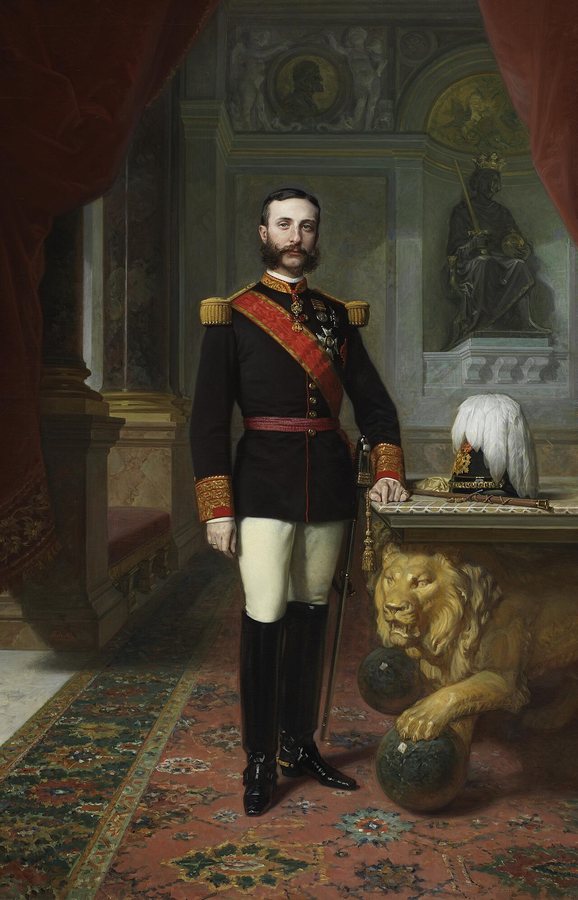


Following the abandonment of the throne by Amadeo of Savoy and the establishment of the First Spanish Republic, a military move led by General Martínez Campos brought the Bourbon restoration about. Antonio Cánovas del Castillo, the king's adviser, became prime minister, and the new civilian regime he built lasted until Primo de Rivera's coup in 1923. In 1876 a campaign against the Carlists, in which the young king took part, defeated Don Carlos.