
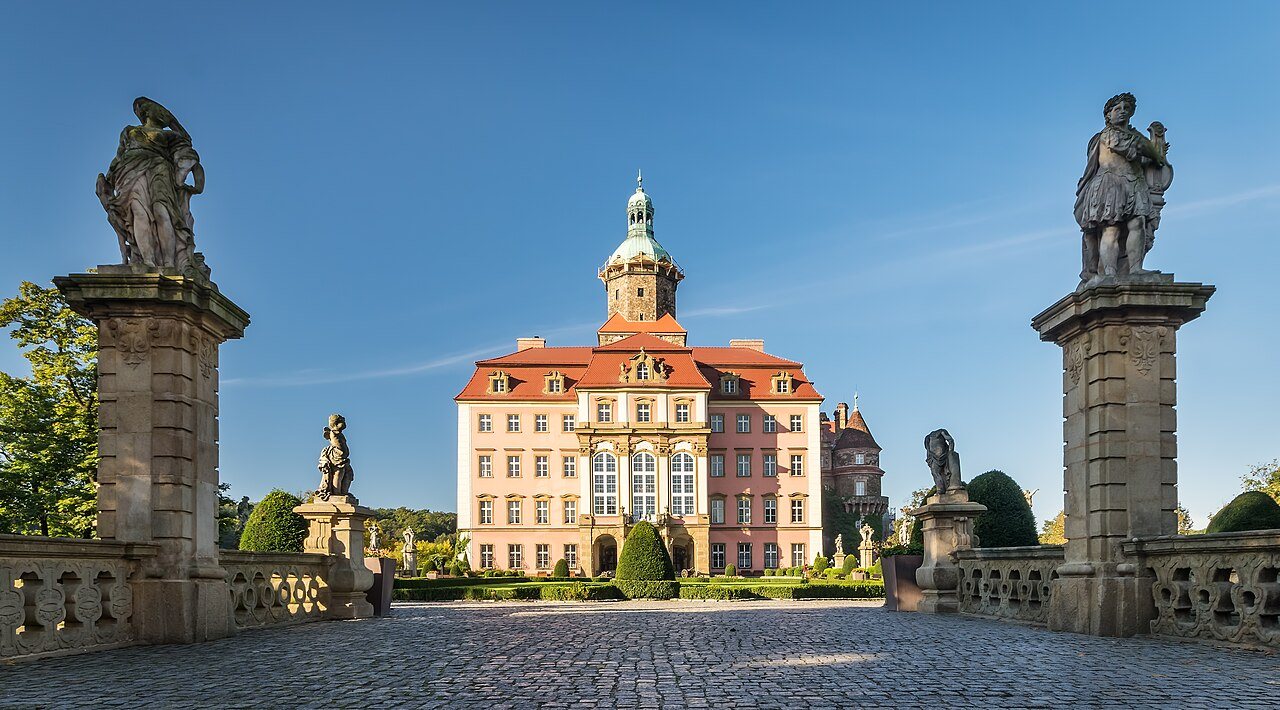
Wałbrzych is a city in the Lower Silesian Voivodeship in southwestern Poland and the seat of Wałbrzych County. It lies about 70 kilometres southwest of the voivodeship capital Wrocław and roughly 30 kilometres from the Czech border. With around 110,000 inhabitants, it is the second-largest city in the voivodeship. Once a major centre of coal mining and industry in Silesia, it is known for its historical architecture and for Książ Castle, the largest castle in Lower Silesia.
Name and origins




The earliest documented mention of the settlement dates to 1305, when it appears in Latinized form as Waldenberc, the first recorded version of the German name Waldenburg, meaning forest castle. The name remained official until 1945, when the city became part of Poland and received its Polish name, Wałbrzych. Some Polish local historians have proposed an earlier Slavic name, Lasogród, but no primary medieval or early-modern document records it, and German historians dispute the existence of an early Slavic settlement at the site.
Industrial history


Coal mining in the area is first mentioned in 1536, and from the sixteenth to the eighteenth century the town was known for wool and linen weaving. It became an industrial centre around the turn of the nineteenth century. After Prussia annexed the city in 1742, it became part of Germany in 1871. The first railway connection to Breslau came in 1843, and a glassworks and a large china factory, both still operating, were built in the early twentieth century.
World War II and after


During the Second World War, the city hosted several forced labour camps holding prisoners of war, Poles, Jews and others, including subcamps of Gross-Rosen. The Red Army conquered the city on 8 May 1945. After the war it became part of Poland under border changes agreed at the Potsdam Conference, and most of its German population fled or was expelled, after which it was resettled mainly by Poles.