
Chinese double hour refers to the shí, a traditional Chinese time unit in which each period was one twelfth of the interval between one midnight and the next, making it roughly twice the length of a modern hour. The shí were named after the twelve earthly branches in order, with midnight falling in the first. This system formed part of the wider traditional Chinese timekeeping standards used from the Han era until the Shixian calendar was introduced in 1644.
Origins and daytime use
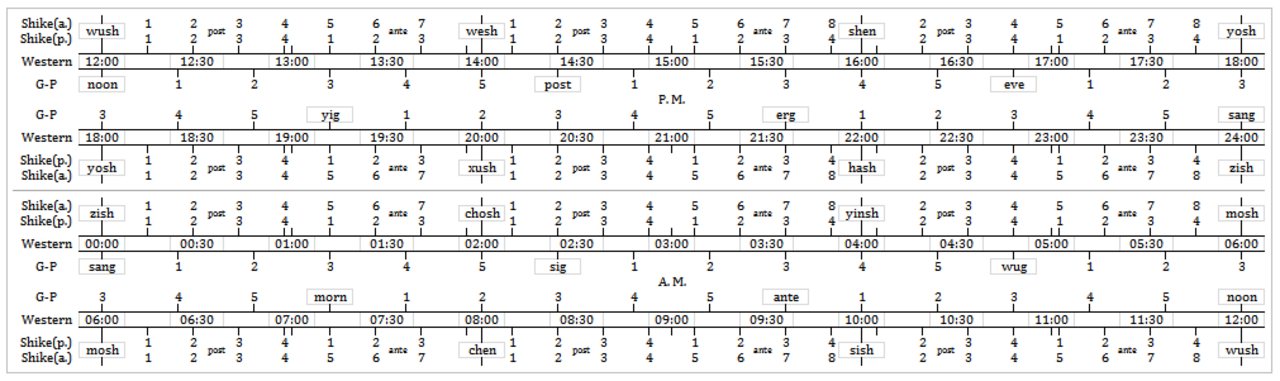
The division of the day into twelve parts appears in the Han-era system, and from the Eastern Han to the Ming dynasty the shí was used to mark daylight time. Its position was derived from the sun. Each shí was further divided into major and minor kè, units that were based on sundials and water clocks, and the time of day could be described either by counting the major kè from the start of a shí or by noting which half of it the moment fell in.
Change of the midnight hour
The timing of the first shí shifted during the Song dynasty. Originally it ran from 23:00 to 01:00, but later it began at midnight, from 00:00 to 02:00. From the end of the Tang dynasty, each shí was also split into two halves, the initial hour and the central hour, which gave a more precise way of stating the time.