factograf
EN
Sign in

former First Secretary of the Communist Party of Cuba

Raúl Castro

Raúl Castro

Raúl Castro is a Cuban politician and general who led the Communist Party of Cuba and the country itself after his brother Fidel. He served as first secretary of the party from 2011 to 2021 and as president of Cuba from 2008 to 2018. A military leader of the Cuban Revolution, he was minister of the Armed Forces for decades and a member of the party's Politburo from 1965 until 2021. Some commentators still regard him as the country's de facto leader.

Early life

Raúl Castro in 2015, cropped version 2
Castro carried by Fulgencio Batista in 1938. In 1959, Castro and his brother toppled Batista from power.
Image from the Oriente newspaper of 30 July 1953 after Castro's capture
Raúl Castro (third from left) with his wife Vilma Espín, brother Fidel Castro and Celia Sánchez on the Second Eastern Front, 1958
4 images

Castro was born in Birán in 1931 to a Spanish immigrant father and a Cuban-born mother of Canarian descent. As a student in Havana he became a committed socialist and joined the Socialist Youth, the youth wing of the island's Communist party. In 1953 he took part in the attack on the Moncada Barracks led by the 26th of July Movement, for which he was imprisoned for 22 months. During his exile in Mexico he helped prepare the expedition of the boat Granma to Cuba.

Role in the revolution

Castro in 1959
Castro in 1959
Raúl Castro as a military officer, standing behind Cipriano Pontigo (first on the left), with Senator Salvador Allende and Hortensia Bussi, August 1959
East German Minister of National Defense Heinz Hoffmann and Raúl Castro near Havana, Cuba, 1977
Vilma Espín, Raúl Castro and Che Guevara on 26 July 1964
4 images

After the Granma landing failed, Castro was one of a small group of fighters who reached the Sierra Maestra mountains and formed the core of the rebel army. He was later promoted to comandante and led operations in Oriente Province, where his forces grew over time. In 1958 his rebels took foreign hostages, a move that drew significant attention in the United States. Batista fled Cuba in January 1959, and the Castro brothers' army soon took control of the country.

Later leadership

Manmohan Singh with Castro on the sidelines of the 14th Non-Aligned Movement Summit in Havana, Cuba, on 15 September 2006
Raúl Castro with Hugo Chávez, 2010
Castro shaking hands with U.S. President Barack Obama in Panama during the Summit of the Americas on 11 April 2015
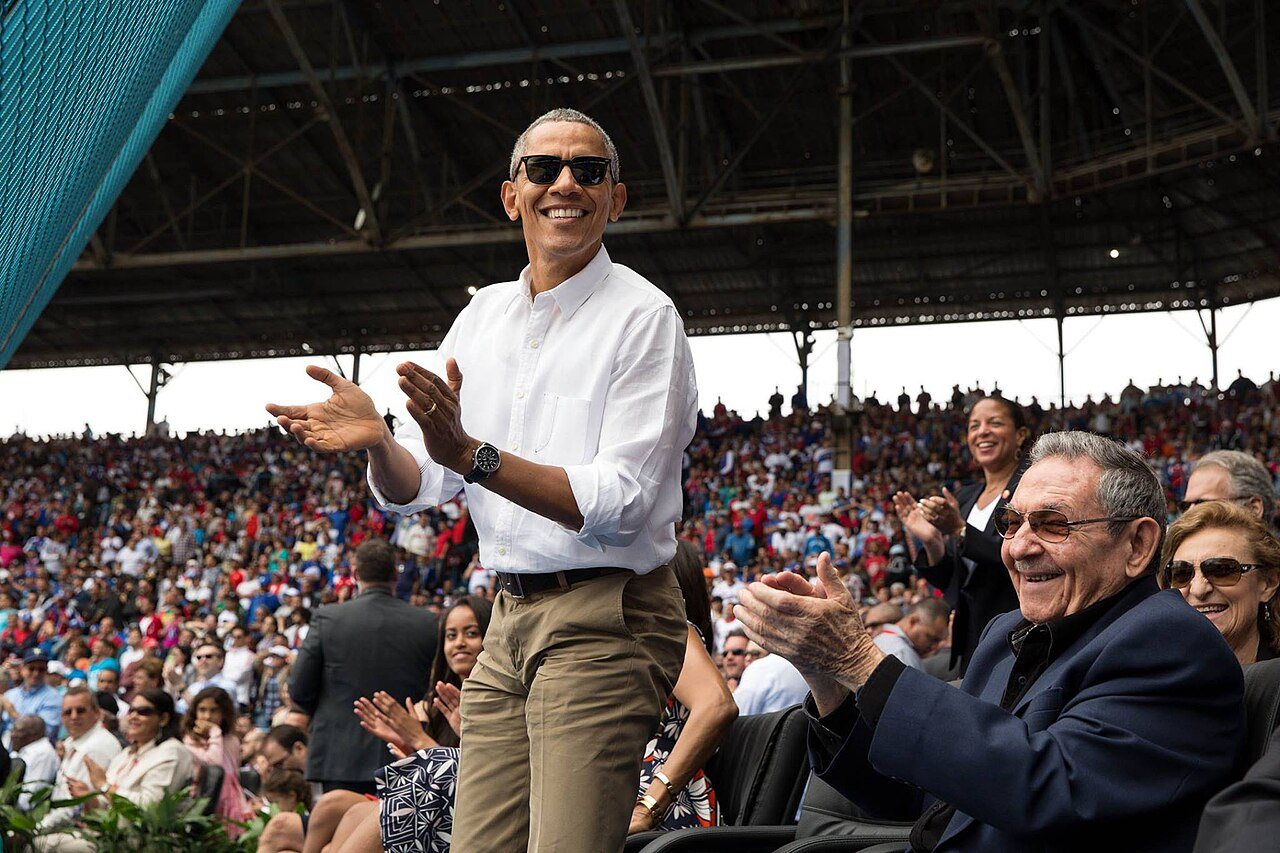
President Barack Obama and President Raúl Castro at an exhibition baseball game between the Tampa Bay Rays and the Cuban National Team at the Estadio Latinoamericano in Havana on 22 March 2016
4 images

Castro held the post of acting president from 2006 while his brother was ill, and was formally made president in 2008. He was re-elected in 2013 but announced that his second term would be his last, stepping down as president in 2018. He remained first secretary of the Communist Party until he announced his retirement at the party's Eighth Congress in 2021, when Miguel Díaz-Canel succeeded him.

In 95 languages

Редакція Factograf · Published October 14, 2026 · Partly based on Wikipedia, CC BY-SA 4.0 · Source article