
Battle of Grunwald was fought on 15 July 1410 during the Polish–Lithuanian–Teutonic War, also known as the (First) Battle of Tannenberg or the Battle of Žalgiris. An alliance of the Kingdom of Poland and the Grand Duchy of Lithuania, led by King Władysław II Jagiełło and Grand Duke Vytautas, decisively defeated the Teutonic Order under Grand Master Ulrich von Jungingen, whose leadership was largely killed or captured. The battle was one of the largest in medieval Europe and is regarded as one of the most important victories in the histories of Poland and Lithuania.
Aftermath and consequences


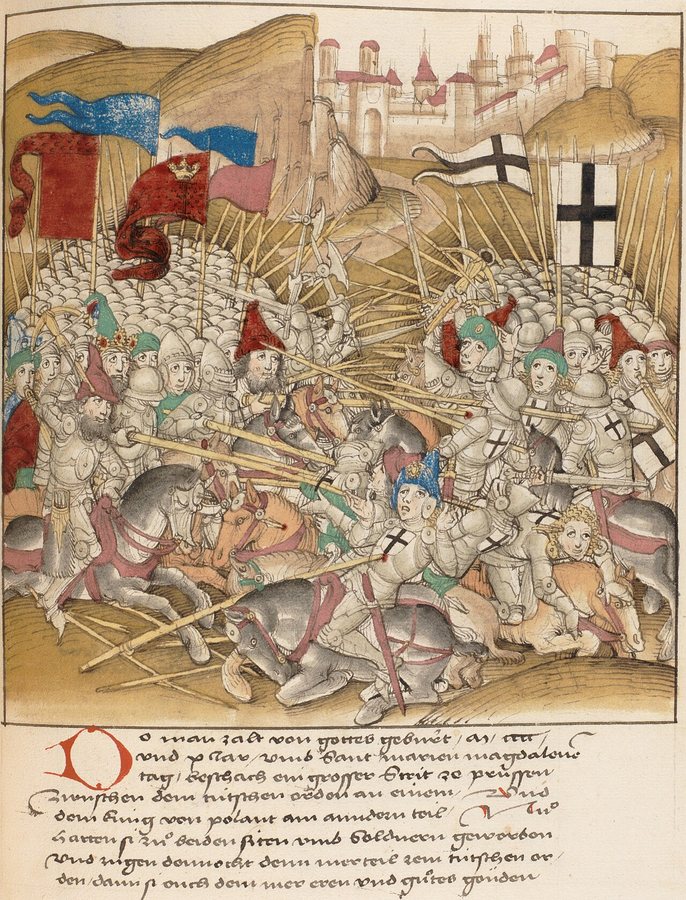
Although defeated, the Teutonic Order withstood a later siege of Malbork Castle and lost little territory at the Peace of Thorn in 1411. Other territorial disputes continued until the Treaty of Melno in 1422. The order never regained its former power, and the financial burden of war reparations caused internal conflicts and an economic downturn in its lands. The battle shifted the balance of power in Central and Eastern Europe and marked the rise of the Polish–Lithuanian union as the dominant regional political and military force.
Naming and memory


The battle's site was traditionally placed between three villages, but research by Swedish historian Sven Ekdahl and archaeological excavations from 2014 to 2017 showed that it lay south of Grunwald. The battle has three common names, each tied to a different nation. For centuries it has been reinterpreted in Poland, Lithuania, Ukraine and Belarus as a symbol of national pride and resistance to foreign invaders. In the twentieth century it was used in Nazi German and Soviet propaganda, and postwar historians have moved toward a more balanced scholarly assessment.