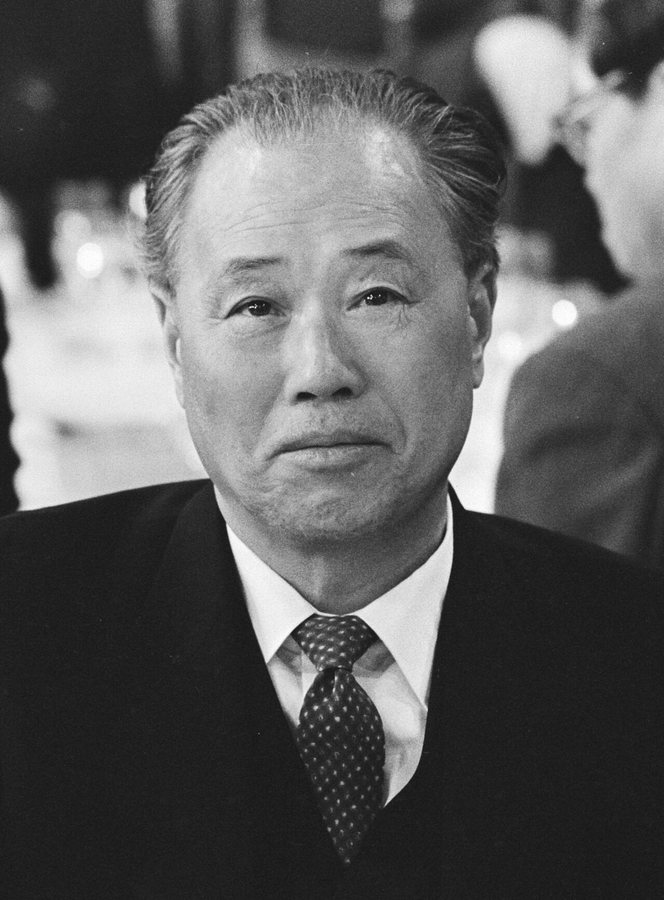
Zhao Ziyang (1919–2005) was a Chinese politician who served as premier of China from 1980 to 1987 and as general secretary of the Chinese Communist Party from 1987 to 1989. He led political reforms from 1986 and lost power for supporting the 1989 Tiananmen Square protests. He spent the rest of his life under house arrest, and his death in Beijing in 2005 went without the funeral rites usually given to senior officials.
Early career


Zhao joined the Communist Party in 1938 and held mainly administrative posts during the Second Sino-Japanese War and the Chinese Civil War. He rose to prominence in Guangdong in the 1950s and 1960s, where he became provincial party secretary in 1965. During the Great Leap Forward he carried out a harsh campaign against peasants, though he later claimed his local arrangements reduced deaths from famine. Historian Jasper Becker holds him partly responsible for the millions who died in Guangdong. His moderate policies later helped agricultural recovery.
Reform and downfall


As a senior official in Sichuan and later as premier, Zhao backed free-market reforms, the privatization of state enterprises, and the separation of party and state. He succeeded Hu Yaobang as general secretary in 1987. His sympathy for student demonstrators in 1989 put him at odds with party elders and Premier Li Peng, and he lost Deng Xiaoping's support. After his removal he became more radical in his political views, favoring a full transition to liberal democracy. His secret memoirs were published abroad in 2009, but his life remains censored in China.