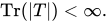
In mathematics, specifically functional analysis, a trace-class operator is a linear operator for which a trace may be defined, such that the trace is a finite number independent of the choice of basis used to compute the trace. This trace of trace-class operators generalizes the trace of matrices studied in linear algebra. All trace-class operators are compact operators.
In quantum mechanics, quantum states are described by density matrices, which are certain trace class operators.
Trace-class operators are essentially the same as nuclear operators, though many authors reserve the term "trace-class operator" for the special case of nuclear operators on Hilbert spaces and use the term "nuclear operator" in more general topological vector spaces (such as Banach spaces).
Definition
Let 


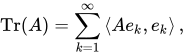
independent of the choice of orthonormal basis. A (not necessarily positive) bounded linear operator 
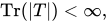
where 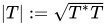
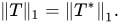
The trace-norm of a trace class operator T is defined as


When 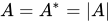
Equivalent formulations
Given a bounded linear operator 

is finite for every orthonormal basis
of H.
- T is a nuclear operator.
- There exist two orthogonal sequences
and
in
in
such that
and
- where
), with each value repeated as often as its multiplicity.
- There exist two orthogonal sequences
- T is a compact operator with
- If T is trace class then
- If T is trace class then
- T is an integral operator.
- T is equal to the composition of two Hilbert-Schmidt operators.
is a Hilbert-Schmidt operator.


Examples
Spectral theorem
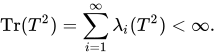
Let 

Mercer's theorem
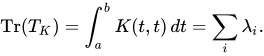
Mercer's theorem provides another example of a trace class operator. That is, suppose 
![{\displaystyle L^{2}([a,b])}](https://wikimedia.org/api/rest_v1/media/math/render/svg/9afbae301dd78d6739e6c45a942076bf669595e9)
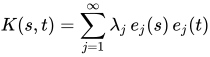
then the associated Hilbert–Schmidt integral operator 
Finite-rank operators
Every finite-rank operator is a trace-class operator. Furthermore, the space of all finite-rank operators is a dense subspace of
Given any 




Properties
- If
Therefore, a self-adjoint operator
and negative part
are both trace-class. (The positive and negative parts of a self-adjoint operator are obtained by the continuous functional calculus.)
- The trace is a linear functional over the space of trace-class operators, that is,
The bilinear map
is an inner product on the trace class; the corresponding norm is called the Hilbert–Schmidt norm. The completion of the trace-class operators in the Hilbert–Schmidt norm are called the Hilbert–Schmidt operators.
is a positive linear functional such that if
then
- If
and
- If
and
are also trace-class (i.e. the space of trace-class operators on H is a two-sided ideal in the algebra of bounded linear operators on H), and
Furthermore, under the same hypothesis,
and
The last assertion also holds under the weaker hypothesis that A and T are Hilbert–Schmidt.
- If
are two orthonormal bases of H and if T is trace class then
- If A is trace-class, then one can define the Fredholm determinant of
:
where
is the spectrum of
The trace class condition on
It also implies that
if and only if
is invertible.
- If
the sum of positive terms
is finite.
- If
for some Hilbert-Schmidt operators
and
then for any normal vector
holds.



Lidskii's theorem
Let 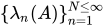



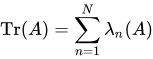
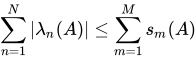
Note that the series on the right converges absolutely due to Weyl's inequality


Relationship between common classes of operators
One can view certain classes of bounded operators as noncommutative analogue of classical sequence spaces, with trace-class operators as the noncommutative analogue of the sequence space 
Indeed, it is possible to apply the spectral theorem to show that every normal trace-class operator on a separable Hilbert space can be realized in a certain way as an 


Recall that every compact operator 






The trace-class operators are given the trace norm ![{\textstyle \|T\|_{1}=\operatorname {Tr} \left[\left(T^{*}T\right)^{1/2}\right]=\sum _{i}\alpha _{i}.}](https://wikimedia.org/api/rest_v1/media/math/render/svg/69ea6673598ad91fd4b978b989d17fd91e9fc07c)
![{\displaystyle \|T\|_{2}=\left[\operatorname {Tr} \left(T^{*}T\right)\right]^{1/2}=\left(\sum _{i}\alpha _{i}^{2}\right)^{1/2}.}](https://wikimedia.org/api/rest_v1/media/math/render/svg/ee61998819726922a21a830029da29fa7a6008d0)



It is also clear that finite-rank operators are dense in both trace-class and Hilbert–Schmidt in their respective norms.
Trace class as the dual of compact operators
The dual space of 





This identification works because the finite-rank operators are norm-dense in 



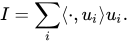
But this means that
A limiting argument using finite-rank operators shows that 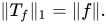

As the predual of bounded operators
Recall that the dual of 



