In mathematics, in particular in functional analysis, the singular values of a compact operator acting between Hilbert spaces
and
, are the square roots of the (necessarily non-negative) eigenvalues of the self-adjoint operator
.
The singular values are non-negative real numbers, usually listed in decreasing order . The largest singular value
is equal to the operator norm of
(see Min-max theorem).
If acts on a Euclidean space (for example,
), there is a simple geometric interpretation for the singular values: Consider the image by
of the unit sphere; this is an ellipsoid, and the lengths of its semi-axes are the singular values of
(the figure provides an example in
).
If is a normal matrix, then its singular values are the absolute values of its eigenvalues. Indeed, in this case, the spectral theorem can be applied to obtain unitary diagonalization of
as
. Then, by definition,
.
Most norms on Hilbert space operators studied are defined using singular values. For example, the Ky Fan -norm is the sum of the first
singular values, the trace norm is the sum of all singular values, and the Schatten norm is the
-th root of the sum of the
-th powers of the singular values. Note that each norm is defined only on a special class of operators, hence singular values can be useful in classifying different operators.
In the finite-dimensional case, a matrix can always be decomposed in the form , where
and
are unitary matrices and
is a rectangular diagonal matrix with the singular values lying on its diagonal. This is the singular value decomposition.
Basic properties
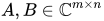
For and
:
Min-max theorem for singular values:
Here, is a subspace of
;
Matrix transpose and conjugate do not alter singular values:
-
.
For any unitary matrices and
,
-
.
Relation to eigenvalues:
-
.
Relation to trace:
-
.
If has full rank, the product of singular values is
.
If has full rank, the product of singular values is
.
If is square and has full rank, the product of singular values is
.
If is normal, then
, that is, its singular values are the absolute values of its eigenvalues.
For a generic rectangular matrix
, let
be its augmented
matrix.
eigenvalues of
are
(where the
are the singular values of
), and the
remaining eigenvalues of
are zero. Let
be the singular value decomposition of
; then the eigenvectors of
for
are
.
The smallest singular value
The smallest singular value of a matrix is
. For a non-singular matrix
, it has the following properties:
.
- For all indices
,
.
Intuitively, if is small, then the rows of
are "almost" linearly dependent. If it is
, then the rows of
are linearly dependent and
is not invertible.
Inequalities about singular values
See also:
Singular values of sub-matrices
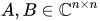
For ,
- Let
denote
with one of its rows or columns deleted. Then
- Let
denote
with two of its rows and columns deleted. Then
- Let
denote an
submatrix of
. Then
Singular values of A + B
For ,
Singular values of AB
For ,
For ,
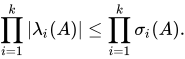
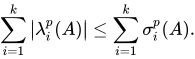
Singular values and eigenvalues
For ,
- See:.
- Assume
. Then for
,
- Weyl's theorem:
- For
,
- Weyl's theorem:
History
This concept was introduced by Erhard Schmidt in 1907. Schmidt called singular values "eigenvalues" at that time. The name "singular value" was first quoted by Smithies in 1937. In 1957, Allahverdiev proved the following characterization of the -th singular number:
This formulation made it possible to extend the notion of singular values to operators in Banach spaces.
Note that there is a more general concept of s-numbers, which also includes Gelfand and Kolmogorov width.