
Sphericity is a measure of how closely the shape of a physical object resembles that of a perfect sphere. For example, the sphericity of the balls inside a ball bearing determines the quality of the bearing, such as the load it can bear or the speed at which it can turn without failing. Sphericity is a specific example of a compactness measure of a shape.
Sphericity applies in three dimensions; its analogue in two dimensions, such as the cross sectional circles along a cylindrical object such as a shaft, is called roundness.
Definition
Defined by Wadell in 1935, the sphericity, 

where 

Ellipsoidal objects
The sphericity,

where a and b are the semi-major and semi-minor axes respectively.
Derivation
Hakon Wadell defined sphericity as the surface area of a sphere of the same volume as the object divided by the actual surface area of the object.
First we need to write surface area of the sphere, 

therefore

hence we define

Sphericity of common objects
| Name | Picture | Volume | Surface area | Sphericity |
|---|---|---|---|---|
| Sphere | 
|

|

| |
| Disdyakis triacontahedron | 
|

|
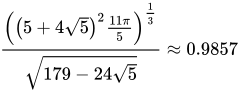
| |
| Tricylinder | 
|

|

| |
| Rhombic triacontahedron | 
|

|

| |
| Icosahedron | 
|

|

| |
| Bicylinder | 
|

|

| |
Ideal bicone
|

|

|

| |
| Dodecahedron | 
|

|

| |
| Rhombic dodecahedron | 
|

|

| |
Ideal torus
|

|

|

| |
Ideal cylinder
|

|

|

| |
| Octahedron | 
|

|

| |
| Hemisphere | 
|

|

| |
| Cube | 
|

|

| |
Ideal cone
|

|

|

| |
| Tetrahedron | 
|

|

|


