factograf
EN
Sign in

war between the republicans and the nationalists in spain from 1936 to 1939

Spanish Civil War

Spanish Civil War

The Spanish Civil War was fought in Spain from 1936 to 1939 between the Republicans, who backed the left-leaning Popular Front government of the Second Spanish Republic, and the Nationalist rebels. The Nationalists, an alliance of Falangists, monarchists, conservatives and traditionalists, won in early 1939 and then ruled Spain until Franco's death in November 1975. The conflict began after a partly failed coup in July 1936, left Spain militarily and politically divided, and drew heavy foreign involvement. It is remembered for the passions it stirred worldwide and for the many atrocities committed on both sides.

Origins and the coup

Spanish 11th International Brigade in battle near Belchite, 1937
The destruction wrought on Granollers after an air raid
Lincoln Battalion
Lincoln Battalion
Civil War, Volume III, 1936–1939
Civil War, Volume II, part 2
Battle of Gettysburg, lithograph by Currier and Ives
On 12 April 1931 the Republicans won the elections, and the Second Spanish Republic was proclaimed two days later. King Alfonso XIII went into exile.
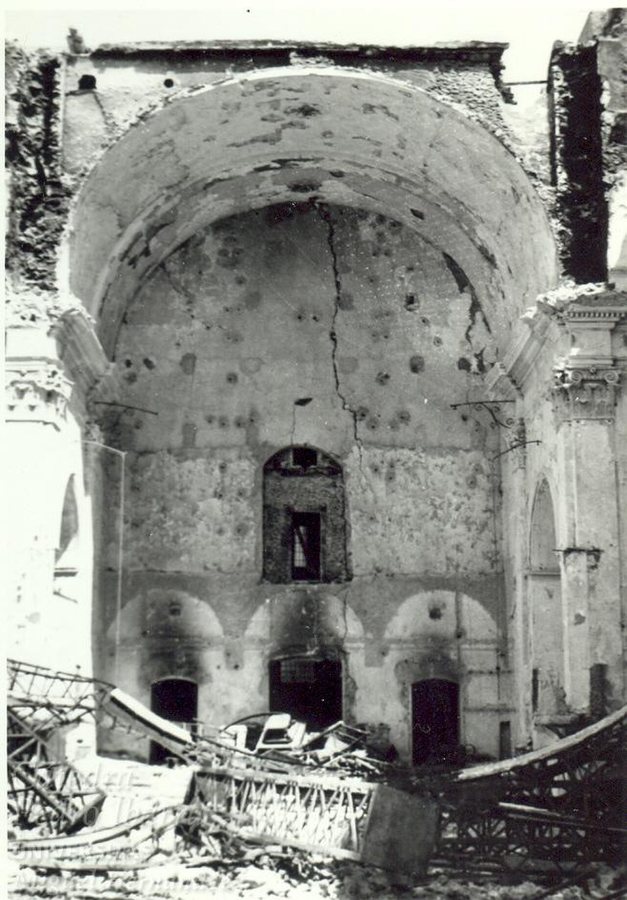
Main altarpiece of the Church of the Salvador in Elche before it was burned by Republicans
Church of the Salvador in Elche after it was burned by Republicans
General José Sanjurjo, leader of the failed 1932 military coup, granted amnesty in 1934 by the right-wing government, later one of the leaders of the 1936 coup.
"On the Run!" Daily Worker, 10 October 1934
Barricades in Barcelona, Daily Worker, 23 November 1934
12 images

Spain's instability in the decades before the war included the overthrow of Isabella II, the short-lived First Republic, and a military dictatorship under Miguel Primo de Rivera. After the Second Republic was founded in 1931, conflict between left and right deepened. In July 1936, a group of generals rebelled against the Popular Front government, but rebel units failed to seize control of almost all major cities, dividing the country. The Nationalists were initially led by a military junta before General Francisco Franco became their supreme leader in October 1936.

Foreign intervention and outcome

Polish volunteers in the International Brigades
Map of Spain in September 1936, showing areas under Nationalist and Republican control.
Surrender of Republican soldiers in the Somosierra area, 1936
Anarchist Buenaventura Durruti was fatally shot after arriving in Madrid to bolster Republican morale during an unsuccessful Francoist siege. His funeral in Barcelona was led by Lluís Companys and Joan García i Oliver.
Alginet weapons factory
Map of Spain in October 1937, showing areas under Nationalist and Republican control.
Ruins of Guernica
Ruins of Guernica
Republican T-26 tank on the Aragon front, November 1937.
Map of Spain in July 1938, showing areas under Nationalist and Republican control.
Map of Spain in February 1939, showing areas under Nationalist and Republican control.
Franco arriving in San Sebastián in 1939
Franco declares the end of the war, though small pockets of Republicans fought on.
12 images

Fascist Italy and Nazi Germany supplied the Nationalists with troops, munitions and air support, while the Soviet Union and Mexico aided the Republicans. Britain, France and the United States officially followed non-intervention, though tens of thousands of volunteers joined the pro-Republican International Brigades. Nationalist advances captured northern Spain and Catalonia, and in March 1939 a coup against the Republican government failed to secure peace. Franco entered Madrid and declared victory on 1 April 1939, after which hundreds of thousands of Republicans fled into exile.

In 115 languages

Редакція Factograf · Published October 14, 2026 · Partly based on Wikipedia, CC BY-SA 4.0 · Source article