In quantum mechanics, separable states are multipartite quantum states that can be written as a convex combination of product states. Product states are multipartite quantum states that can be written as a tensor product of states in each space. The physical intuition behind these definitions is that product states have no correlation between the different degrees of freedom, while separable states might have correlations, but all such correlations can be explained as due to a classical random variable, as opposed to being due to entanglement.
In the special case of pure states the definition simplifies: a pure state is separable if and only if it is a product state.
A state is said to be entangled if it is not separable. In general, determining if a state is separable is not straightforward and the problem is classed as NP-hard.
Separability of bipartite systems
Consider first composite states with two degrees of freedom, referred to as bipartite states. By a postulate of quantum mechanics these can be described as vectors in the tensor product space 


Pure states
Let 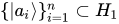



where 



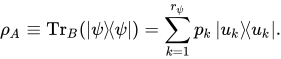
Pure states are entangled if and only if their partial states are not pure. To see this, write the Schmidt decomposition of
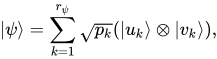
where 

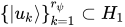
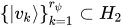

It follows that 

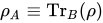
Physically, this means that it is not possible to assign a definite (pure) state to the subsystems, which instead ought to be described as statistical ensembles of pure states, that is, as density matrices. A pure state 
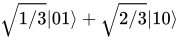
Formally, the embedding of a product of states into the product space is given by the Segre embedding. That is, a quantum-mechanical pure state is separable if and only if it is in the image of the Segre embedding.
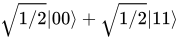
For example, in a two-qubit space, where 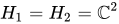



Mixed states
Consider the mixed state case. A mixed state of the composite system is described by a density matrix 


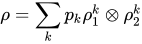
where
Otherwise
Notice that, again from the definition of the tensor product, any density matrix, indeed any matrix acting on the composite state space, can be trivially written in the desired form, if we drop the requirement that 
In terms of quantum channels, a separable state can be created from any other state using local actions and classical communication while an entangled state cannot.
When the state spaces are infinite-dimensional, density matrices are replaced by positive trace class operators with trace 1, and a state is separable if it can be approximated, in trace norm, by states of the above form.
If there is only a single non-zero 


Extending to the multipartite case
The above discussion generalizes easily to the case of a quantum system consisting of more than two subsystems. Let a system have n subsystems and have state space 


Similarly, a mixed state ρ acting on H is separable if it is a convex sum
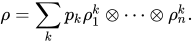
Or, in the infinite-dimensional case, ρ is separable if it can be approximated in the trace norm by states of the above form.
Separability criterion
The problem of deciding whether a state is separable in general is sometimes called the quantum separability problem in quantum information theory. It is considered to be a difficult problem. It has been shown to be NP-hard in many cases and is believed to be so in general. Some appreciation for this difficulty can be obtained if one attempts to solve the problem by employing the direct brute force approach, for a fixed dimension. The problem quickly becomes intractable, even for low dimensions. Thus more sophisticated formulations are required. The separability problem is a subject of current research.
A separability criterion is a necessary condition a state must satisfy to be separable. In the low-dimensional (2 X 2 and 2 X 3) cases, the Peres–Horodecki criterion is actually a necessary and sufficient condition for separability. Other separability criteria include (but not limited to) the range criterion, reduction criterion, and those based on uncertainty relations. See Ref. for a review of separability criteria in discrete variable systems.
In continuous variable systems, the Peres–Horodecki criterion also applies. Specifically, Simon formulated a particular version of the Peres–Horodecki criterion in terms of the second-order moments of canonical operators and showed that it is necessary and sufficient for 


Testing for separability
Testing for separability in the general case is an NP-hard problem. Leinaas et al. formulated an iterative, probabilistic algorithm for testing if a given state is separable. When the algorithm is successful, it gives an explicit, random, representation of the given state as a separable state. Otherwise it gives the distance of the given state from the nearest separable state it can find.
Optimization over the set of separable states
The set of separable states appear in computing the convex roof of a function defined on pure states 

where the optimization is over all decompositions of the density matrix of the form

It has been proven that
the convex roof of any quantity that can be written as a 

where 


where 


The next example shows a relevant convex roof in quantum physics. The quantum Fisher information can be given as four times the convex roof of the variance
![{\displaystyle F_{Q}[\varrho,H]=4\min _{\{p_{k},|\Psi _{k}\rangle \}}\sum _{k}p_{k}(\Delta H)_{\Psi _{k}}^{2}.}](https://wikimedia.org/api/rest_v1/media/math/render/svg/5586541d15b7ee635d3a22bb53e27d09ca580058)
The optimization problem can be written as
![{\displaystyle {\begin{aligned}F_{Q}[\varrho,H]=\min _{\varrho _{12}}\;&2{\rm {Tr}}[(H\otimes {\rm {Identity}}-{\rm {Identity}}\otimes H)^{2}\varrho _{12}],\\{\textrm {s.t.}}\;&\varrho _{12}\in {\rm {Sep}},\\&{\rm {Tr}}_{2}(\varrho _{12})=\varrho,\\&{\rm {Tr}}_{1}(\varrho _{12})=\varrho,\end{aligned}}}](https://wikimedia.org/api/rest_v1/media/math/render/svg/3da4247e78a2d5fbd5e5c65fe593940419ba5450)
where Sep is the set of bipartite separable states.
Another example is the convex roof of the linear entropy of the reduced state in a bipartite system
![{\displaystyle E_{\rm {lin}}(\varrho)=\min _{\{p_{k},|\Psi _{k}\rangle \}}\sum _{k}p_{k}\{1-{\rm {Tr}}[{\rm {Tr_{2}}}(|\Psi _{k}\rangle \langle \Psi _{k}|)^{2}]\},}](https://wikimedia.org/api/rest_v1/media/math/render/svg/5ea830ac64c8b549afea56b6bc35d447bc89ce6b)
which is zero if and only if the density matrix is separable.
A polinomial with 
A similar idea has been used to define the quantum Wasserstein distance based on an optimization over separable states. In particular, the distance
beween states 
![{\displaystyle {\begin{aligned}D_{\rm {sep}}(\varrho,\sigma)^{2}={\frac {1}{2}}\min _{\varrho _{12}}&\sum _{n=1}^{N}\;{\rm {Tr}}[(H_{n}\otimes {\rm {Identity}}-{\rm {Identity}}\otimes H_{n})^{2}\varrho _{12}],\\{\textrm {s.t.}}\;&\varrho _{12}\in \mathrm {Sep},\\&{\rm {Tr}}_{1}(\varrho _{12})=\varrho,\\&{\rm {Tr}}_{2}(\varrho _{12})=\sigma,\end{aligned}}}](https://wikimedia.org/api/rest_v1/media/math/render/svg/2598999a02f317a53b4c154819da81ffe6c7607f)
where 

