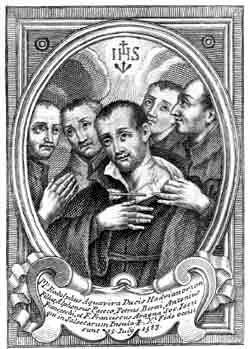
Rodolfo Acquaviva was an Italian Jesuit priest who served as a missionary in India during the late 16th century. Born in Atri to a noble family, he joined the Society of Jesus in 1568 and later traveled to India in 1578. He is most recognized for his time at the Mughal court of Akbar the Great, where he participated in religious debates. His missionary work eventually led to his death in 1583 during a revolt in Cuncolim, resulting in his status as a blessed in the Catholic Church.
Missionary work


After teaching at Saint Paul's College in Goa, Acquaviva led a mission to the court of the Mughal Emperor Akbar. He participated in discussions at the Ibadat Khana, a house of worship designed for interfaith dialogue. Despite the Emperor's interest in various religious traditions, the Jesuit found it difficult to advance his specific religious goals. He eventually returned to Goa to lead a mission among the Hindu Kshatriyas of Salcette.
Death and veneration

Acquaviva's activities in Salcette contributed to the Cuncolim Revolt in July 1583, during which he was killed while praying. He was beatified by Pope Leo XIII in 1893 alongside four of his companions. The Catholic Church commemorates him as a blessed, and the Jesuit order honors him on February 4 as one of the martyrs of the missions.