In algebraic number theory, a quadratic field is an algebraic number field of degree two over 
Every such quadratic field is some 


Quadratic fields have been studied in great depth, initially as part of the theory of binary quadratic forms. There remain some unsolved problems. The class number problem is particularly important.
Discriminant
For a nonzero square free integer 


The set of discriminants of quadratic fields is exactly the set of fundamental discriminants (apart from
Prime factorization into ideals
Any prime number 


is a prime ideal.
- The quotient ring is the finite field with
elements:
.
- The quotient ring is the product
.
- The quotient ring contains non-zero nilpotent elements.
The third case happens if and only if 


The law of quadratic reciprocity implies that the splitting behaviour of a prime
Class group
Determining the class group of a quadratic field extension can be accomplished using Minkowski's bound and the Kronecker symbol because of the finiteness of the class group. A quadratic field 
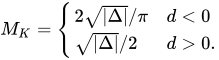
Then, the ideal class group is generated by the prime ideals whose norm is less than 


Quadratic subfields of cyclotomic fields
The quadratic subfield of the prime cyclotomic field
A classical example of the construction of a quadratic field is to take the unique quadratic field inside the cyclotomic field generated by a primitive 


Other cyclotomic fields
If one takes the other cyclotomic fields, they have Galois groups with extra
Orders of quadratic number fields of small discriminant
The following table shows some orders of small discriminant of quadratic fields. The maximal order of an algebraic number field is its ring of integers, and the discriminant of the maximal order is the discriminant of the field. The discriminant of a non-maximal order is the product of the discriminant of the corresponding maximal order by the square of the determinant of the matrix that expresses a basis of the non-maximal order over a basis of the maximal order. All these discriminants may be defined by the formula of Discriminant of an algebraic number field § Definition.
For real quadratic integer rings, the ideal class number, which measures the failure of unique factorization, is given in OEIS A003649; for the imaginary case, they are given in OEIS A000924.
| Order | Discriminant | Class number | Units | Comments |
|---|---|---|---|---|
![{\displaystyle \mathbf {Z} \left[{\sqrt {-5}}\right]}](https://wikimedia.org/api/rest_v1/media/math/render/svg/42df678ad04d08858e2c510db544b3ce65f4c68f)
|

|
|

|
Ideal classes  , , 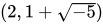
|
![{\displaystyle \mathbf {Z} \left[{\tfrac {1}{2}}(1+{\sqrt {-19}})\right]}](https://wikimedia.org/api/rest_v1/media/math/render/svg/89fd6adc34f901681b33d0b086b2abfc8fee0bab)
|

|
|
|
Principal ideal domain, not Euclidean |
![{\displaystyle \mathbf {Z} \left[2{\sqrt {-1}}\right]}](https://wikimedia.org/api/rest_v1/media/math/render/svg/6d006b1614805d7cb4d887adbed62bcda1e17142)
|

|
|
|
Non-maximal order |
![{\displaystyle \mathbf {Z} \left[{\tfrac {1}{2}}(1+{\sqrt {-15}})\right]}](https://wikimedia.org/api/rest_v1/media/math/render/svg/1a5f344740a9f2cd143fb83ce2e1d8c78643a952)
|

|
|
|
Ideal classes , 
|
![{\displaystyle \mathbf {Z} \left[{\sqrt {-3}}\right]}](https://wikimedia.org/api/rest_v1/media/math/render/svg/eaadf9a3ab3bbca6cc5ea2ac76f4ecb0d289b3fe)
|

|
|
|
Non-maximal order |
![{\displaystyle \mathbf {Z} \left[{\tfrac {1}{2}}(1+{\sqrt {-11}})\right]}](https://wikimedia.org/api/rest_v1/media/math/render/svg/bd1048a12108814922f117ae41b0039e7a4fb4a2)
|

|
|
|
Euclidean |
![{\displaystyle \mathbf {Z} \left[{\sqrt {-2}}\right]}](https://wikimedia.org/api/rest_v1/media/math/render/svg/49f1890315aa0a4ee44cea397a9a9fd1e7656c28)
|

|
|
|
Euclidean |
![{\displaystyle \mathbf {Z} \left[{\tfrac {1}{2}}(1+{\sqrt {-7}})\right]}](https://wikimedia.org/api/rest_v1/media/math/render/svg/480817cbdbe81a6ccf220a3c1832ef5050525ba2)
|

|
|
|
Kleinian integers |
![{\displaystyle \mathbf {Z} \left[{\sqrt {-1}}\right]}](https://wikimedia.org/api/rest_v1/media/math/render/svg/292a60e3277b75e1f92c0e9cc4fe52d477b6e625)
|
|
|

(cyclic of order |
Gaussian integers |
![{\displaystyle \mathbf {Z} \left[{\tfrac {1}{2}}(1+{\sqrt {-3}})\right]}](https://wikimedia.org/api/rest_v1/media/math/render/svg/36c60b2023912db4ac840765daff27fb0ba89b15)
|

|
|

(cyclic of order |
Eisenstein integers |
![{\displaystyle \mathbf {Z} \left[{\sqrt {-21}}\right]}](https://wikimedia.org/api/rest_v1/media/math/render/svg/96a8977b3ebce41707644222e5c8cdbe9f407b34)
|

|
|
Class group non-cyclic: 
| |
![{\displaystyle \mathbf {Z} \left[{\tfrac {1}{2}}(1+{\sqrt {5}})\right]}](https://wikimedia.org/api/rest_v1/media/math/render/svg/d65ddfce7607321b2639139de0857299ccdf8d95)
|

|
|

(norm |
Golden integers |
![{\displaystyle \mathbf {Z} \left[{\sqrt {2}}\right]}](https://wikimedia.org/api/rest_v1/media/math/render/svg/6ff50c2ac57bc8125df6849d027ac35a7f59abc1)
|

|
|

(norm |
|
![{\displaystyle \mathbf {Z} \left[{\sqrt {3}}\right]}](https://wikimedia.org/api/rest_v1/media/math/render/svg/4cc291481fdc28f79dce24e16839e24d560235b9)
|

|
|

(norm |
|
![{\displaystyle \mathbf {Z} \left[{\tfrac {1}{2}}(1+{\sqrt {13}})\right]}](https://wikimedia.org/api/rest_v1/media/math/render/svg/5bf2124f5f4305cf9ed0e59a652d7f68c3aae464)
|

|
|

(norm |
|
![{\displaystyle \mathbf {Z} \left[{\tfrac {1}{2}}(1+{\sqrt {17}})\right]}](https://wikimedia.org/api/rest_v1/media/math/render/svg/3a831a3baaf4f6dabef2eeb4566076b1b47ee86e)
|

|
|

(norm |
|
![{\displaystyle \mathbf {Z} \left[{\sqrt {5}}\right]}](https://wikimedia.org/api/rest_v1/media/math/render/svg/c4725de486d74cf82c3eb2a0b505ed710be858d7)
|

|
|

(norm |
Non-maximal order |


Some of these examples are listed in Artin, Algebra (2nd ed.), §13.8.