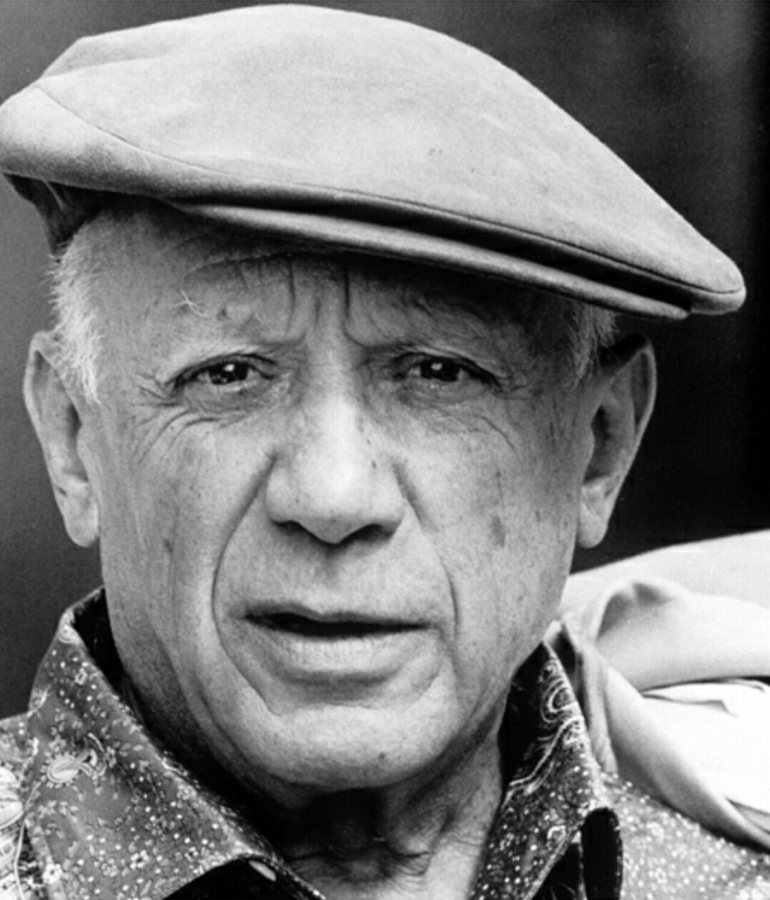
Pablo Picasso was a Spanish painter and sculptor who spent most of his adult life in France. He is known for co-founding the Cubist movement, inventing constructed sculpture, co-inventing collage, and developing a wide variety of styles. His career spanned more than 76 years, from his late teens until his death in 1973, and he became one of the best-known figures in 20th-century art.
Early life and training


Picasso was born in Málaga in southern Spain in 1881, the first child of a painter who taught art at a school of crafts. He began formal training under his father at the age of seven and showed exceptional talent, working in a naturalistic manner through his childhood. After the family moved to Barcelona, he entered the advanced class of its School of Fine Arts at thirteen, and later went to Madrid, where he admired the works of El Greco.
Periods and major works


Picasso's output is often divided into periods, including the Blue Period, the Rose Period, the African-influenced period, and Analytic and Synthetic Cubism. His early experiments were prompted in part by the Fauvist work of Henri Matisse, with whom he became a rival and was often paired by critics as a leader of modern art. Among his best-known works are the proto-Cubist Les Demoiselles d'Avignon and Guernica, a painting protesting the bombing of the Basque town during the Spanish Civil War.