factograf
EN
Sign in

administrative centre of Nizhny Novgorod Oblast in central Russia

Nizhny Novgorod

Nizhny Novgorod

Nizhny Novgorod is the administrative centre and largest city of Nizhny Novgorod Oblast, as well as the administrative centre of the Volga Federal District in Russia. Located at the confluence of the Oka and Volga rivers, it is the sixth-largest city in Russia and an important economic, architectural, educational and cultural centre. The city provides most of Russia's river tourism. It was known as Gorky from 1932 to 1990, named after the writer Maxim Gorky, who was born there.

Medieval origins

The Spit of Nizhny Novgorod at sunset, 30 June 2022
Nizhny Novgorod, 16 May 2022
Gorky Automobile Plant, main entrance, September 2019
Nizhny Novgorod, 1 September 2021
Nizhny Novgorod trade fair, 1 November 2021
Kuzma Minin calls on the people of Nizhny Novgorod to raise a volunteer army against the Poles (painting by Konstantin Makovsky, 1896).
Main building of the Great Russian Fair, 19th-century postcard
Victory Day on Minin and Pozharsky Square, 9 May 1945
Nizhny Novgorod, 1 May 2022
Gorky State Academic Drama Theatre in Nizhny Novgorod
Nizhny Novgorod, 1 May 2022
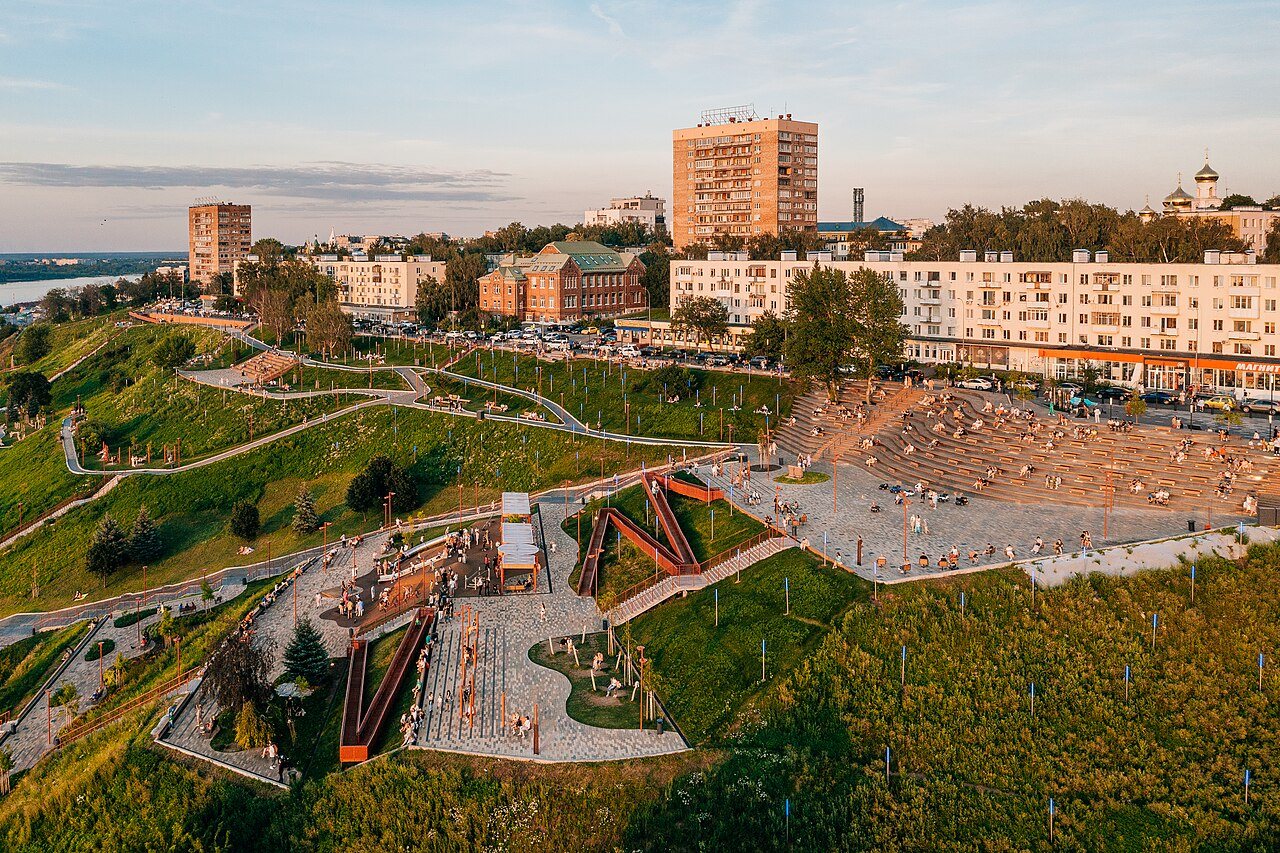
The Fyodorovsky embankment has a unique landscape
12 images

The city was founded on 4 February 1221 by Prince George II of Vladimir as a small wooden hillfort at the confluence of the Volga and Oka rivers. It served as a border stronghold against Mordvin attacks and survived the Mongol invasion, later growing into an important political centre under the Golden Horde. In the 14th century its princes made it a seat of power rivalling Moscow, and in 1392 it was incorporated into the Grand Principality of Moscow. Its red-brick Kremlin, built in the early 16th century, remains the historic core of the city.

Trade and industry

River terminal
River terminal
Nizhny Novgorod-Bor cableway
Strigino International Airport
Nizhny Novgorod banner
The Main Fair Building
Bolshaya Pokrovskaya Street
The State Art Gallery
Pechersky Ascension Monastery
Alexander Nevsky Cathedral (New Fair Cathedral)
Nizhny Novgorod branch of the State Bank on Bolshaya Pokrovskaya Street
Aerial view of the Nizhny Novgorod Kremlin
Verkhne-Volzhskaya embankment, 2024
12 images

In 1817 the Makaryev Fair was moved to Nizhny Novgorod, attracting millions of visitors each year and establishing the city as the trade capital of the Russian Empire. An All-Russia industrial and art exhibition in 1896 showcased inventions by engineers Alexander Popov and Vladimir Shukhov. During the Soviet period the city became a major industrial centre, and the Gorky Automobile Plant was built there, earning it the nickname "Russian Detroit". The city regained its original name shortly before the Soviet Union dissolved.

In 126 languages

Редакція Factograf · Published October 14, 2026 · Partly based on Wikipedia, CC BY-SA 4.0 · Source article