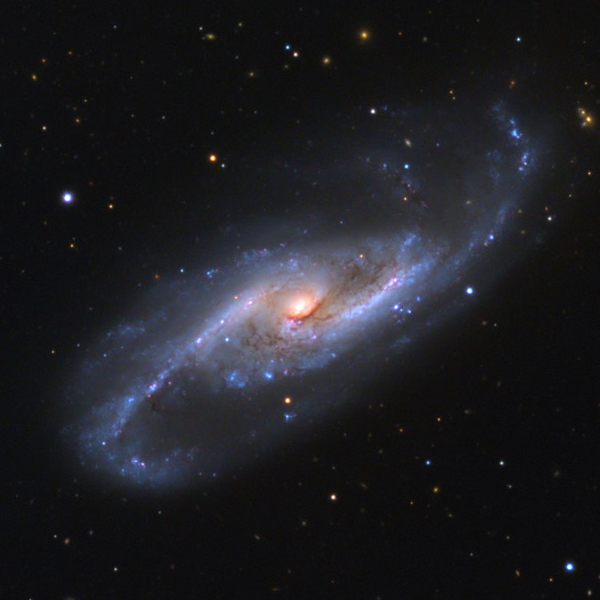
NGC 4536 is an intermediate spiral galaxy in the constellation Virgo. It was discovered by German-British astronomer William Herschel on 24 January 1784.
NGC 4536 is located about 10° south of the midpoint of the Virgo Cluster. However, it is not considered a member of the cluster. Rather, it is a member of the M61 Group of galaxies, which is a member of the Virgo II Groups, a series of galaxies and galaxy clusters strung out from the southern edge of the Virgo Supercluster. The morphological classification in the De Vaucouleurs system is SAB(rs)bc, which indicates it is a weakly barred spiral galaxy with a hint of an inner ring structure plus moderate to loosely wound arms. It does not have a classical bulge around the nucleus.
NGC 4536 has the optical characteristics of an HII galaxy, which means it is undergoing a strong burst of star formation. This is occurring prominently in the ring that surrounds the bar and nucleus. Based upon the level of X-ray emission from the core, it may have a small supermassive black hole with 104–106 times the mass of the Sun.
Supernova
One supernova has been observed in NGC 4536: SN 1981B (Type Ia, mag. 12.3) was discovered by Dmitry Tsvetkov on 2 March 1981, located 51 arcseconds to the northeast of the Galactic Center. It reached a peak visual magnitude of 12 on March 8 before steadily fading from view over the next two months.
Gallery


