
Maslow's hierarchy of needs is a conceptual model of the needs and goals that motivate human behaviour, proposed in 1943 by the American psychologist Abraham Maslow. It arranges five sets of basic needs, from physiological needs at the base to self-actualization at the top, in a hierarchy of prepotency, meaning that a higher need tends to emerge once lower needs are largely satisfied. The model is often drawn as a pyramid, although Maslow did not create that diagram himself. It remains widely used in education, management training, healthcare and social work, though its empirical support is disputed.
Historical development
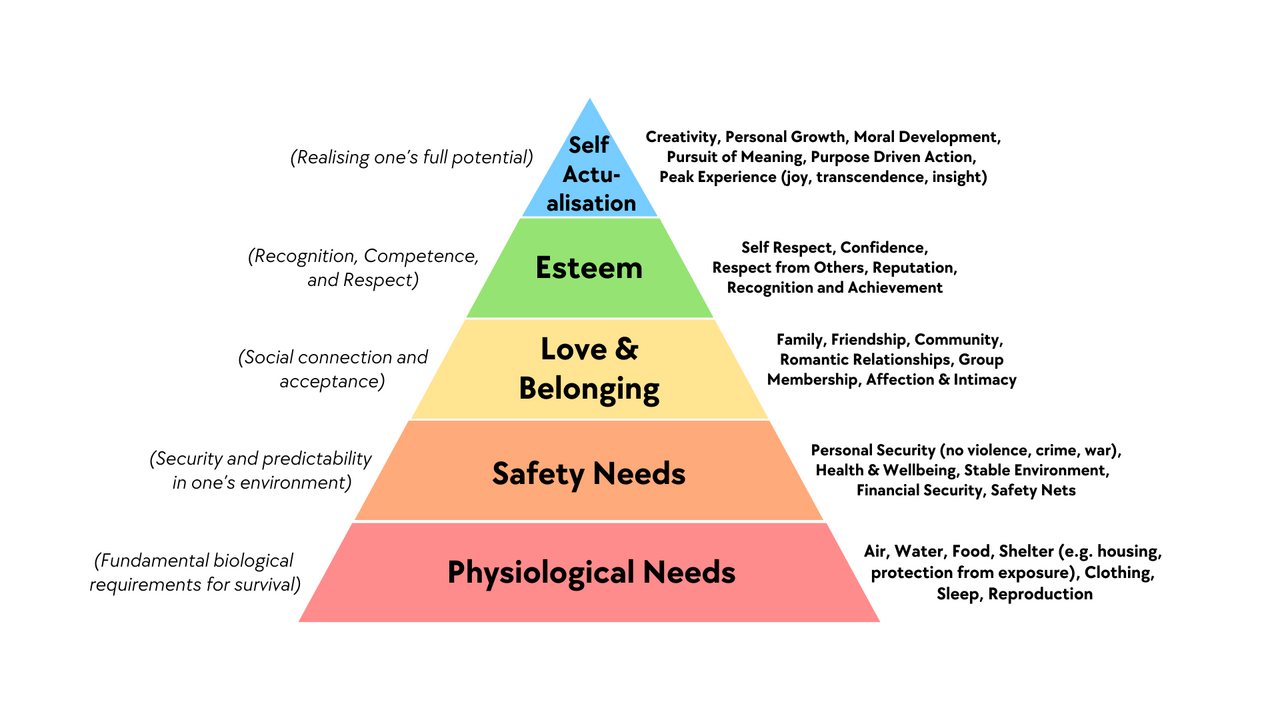
Maslow introduced the framework in his 1943 paper A Theory of Human Motivation in the journal Psychological Review. He divided needs into deficiency needs and growth needs. He stressed that a need does not have to be fully satisfied before the next one emerges, and proposed that a more realistic picture describes decreasing percentages of satisfaction as one moves up the hierarchy. He also introduced the term metamotivation for people who go beyond basic needs and strive for continual betterment.
The pyramid and its critics
The familiar pyramid was first drawn by the consulting psychologist Charles McDermid, not by Maslow. Alternative illustrations, including one showing overlapping waves of needs, have since been proposed. Critics note that the hierarchy lacks conclusive supporting evidence and that its validity remains contested, even though it continues to be a popular framework in many fields.