
Mao Zedong (1893–1976) was a Chinese communist revolutionary and political theorist who founded the People's Republic of China. Serving as China's paramount leader from 1949 until his death, he rose primarily through his role as chairman of the Chinese Communist Party. His adaptation of Marxism–Leninism, known as Mao Zedong Thought, influenced Maoist movements around the world. Historians credit him with ending imperialism, consolidating the Chinese state, and turning China into a major world power, while also holding him responsible for severe famine, political persecution and millions of deaths.
Early life and rise


Born to a peasant family in Hunan during the late Qing dynasty, Mao was shaped by the 1911 Xinhai Revolution, Chinese nationalism and anti-imperialist ideas. He encountered Marxism while working as a librarian at Peking University and took part in the May Fourth Movement of 1919. In 1921 he became a founding member of the Chinese Communist Party, and during the Long March of 1935 he became its leader.
Rule and major campaigns


After the Chinese Civil War, Mao defeated the Nationalist government, which withdrew to Taiwan in 1949. His rule included land redistribution, industrialisation and the suppression of opponents. The Great Leap Forward from 1958 to 1962 was followed by the Great Chinese Famine, and the Cultural Revolution, launched in 1966, brought violent class struggle and a cult of personality. China under his leadership has been described as totalitarian.
Legacy


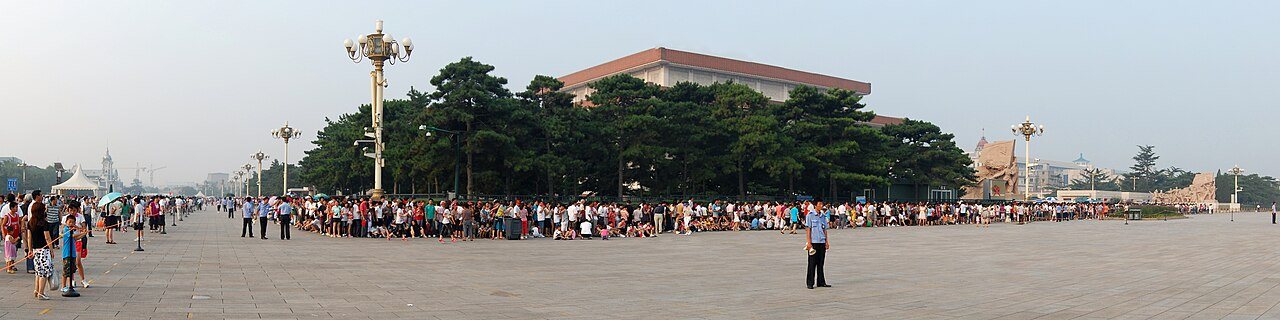

Mao died in 1976 and was succeeded by Hua Guofeng, then by Deng Xiaoping in 1978. Under Mao, the People's Republic replaced the Republic of China on the United Nations Security Council and became the fifth state to possess nuclear weapons. Supporters credit him with promoting literacy, women's rights and basic healthcare, while critics emphasise the deaths and persecution during his rule.