factograf
EN
Sign in

German politician, Chancellor of West Germany (1949–1963), Zentrum and CDU

Konrad Adenauer

Konrad Adenauer

Konrad Adenauer was a German statesman who served as the first chancellor of West Germany from 1949 to 1963. He also led the Christian Democratic Union (CDU) from 1946 to 1966, a party that became the dominant force in the country under his leadership. A devout Catholic, he is considered one of the founding fathers of the European Union. During his years in power he rebuilt the West German economy, restored the country's standing in the world, and tied it closely to the Western powers.

Cologne years

Konrad Adenauer's signature, transparent background
Adenauer in 1896
Adenauer in 1896
Bond of the City of Cologne issued 1 October 1928, bearing a facsimile of Adenauer's signature
In Wilhelmshaven in 1928, a new cruiser is named Köln after Adenauer's home city; he stands centre with Wilhelm Groener and Gustav Noske
Heinrich Hoerle's 1931 modernist painting Contemporaries, showing Mayor Adenauer in grey with artists and a boxer
Adenauer in 1951 reading at his Rhöndorf house, built in 1937, now a museum
1949 CDU election poster: 'With Adenauer for peace, freedom and unity of Germany, therefore CDU'
Adenauer speaking in the Bundestag in 1955
Adenauer with Israeli President Zalman Shazar in 1966
Konrad Adenauer with economics minister Ludwig Erhard in 1956
Adenauer (left) at the signing of the North Atlantic Treaty in Paris in 1954
11 images

Before entering national politics, Adenauer was a leading figure in the Catholic Centre Party during the Weimar Republic. He served as Mayor of Cologne from 1917 to 1933 and as president of the Prussian State Council. As mayor he rebuilt the University of Cologne, supervised major infrastructure projects, and kept order during the unrest that followed the First World War. He also argued for the separation of the Rhineland from Prussia, a proposal that Berlin rejected.

Chancellorship and foreign policy

Minister Blank and Adenauer with General Speidel inspect newly created Bundeswehr units on 20 January 1955
Bulganin, Malenkov and Khrushchev greet Adenauer in Moscow in September 1955
Adenauer with the mother of a German prisoner of war brought home from the Soviet Union in 1955 after his Moscow visit
Adenauer and Italian Prime Minister Antonio Segni in August 1959
US President John F. Kennedy, Willy Brandt and Adenauer at the Berlin Wall in 1963
Adenauer with French President Charles de Gaulle in 1963
Adenauer delivering a speech at the March 1966 CDU party rally, one year before his death
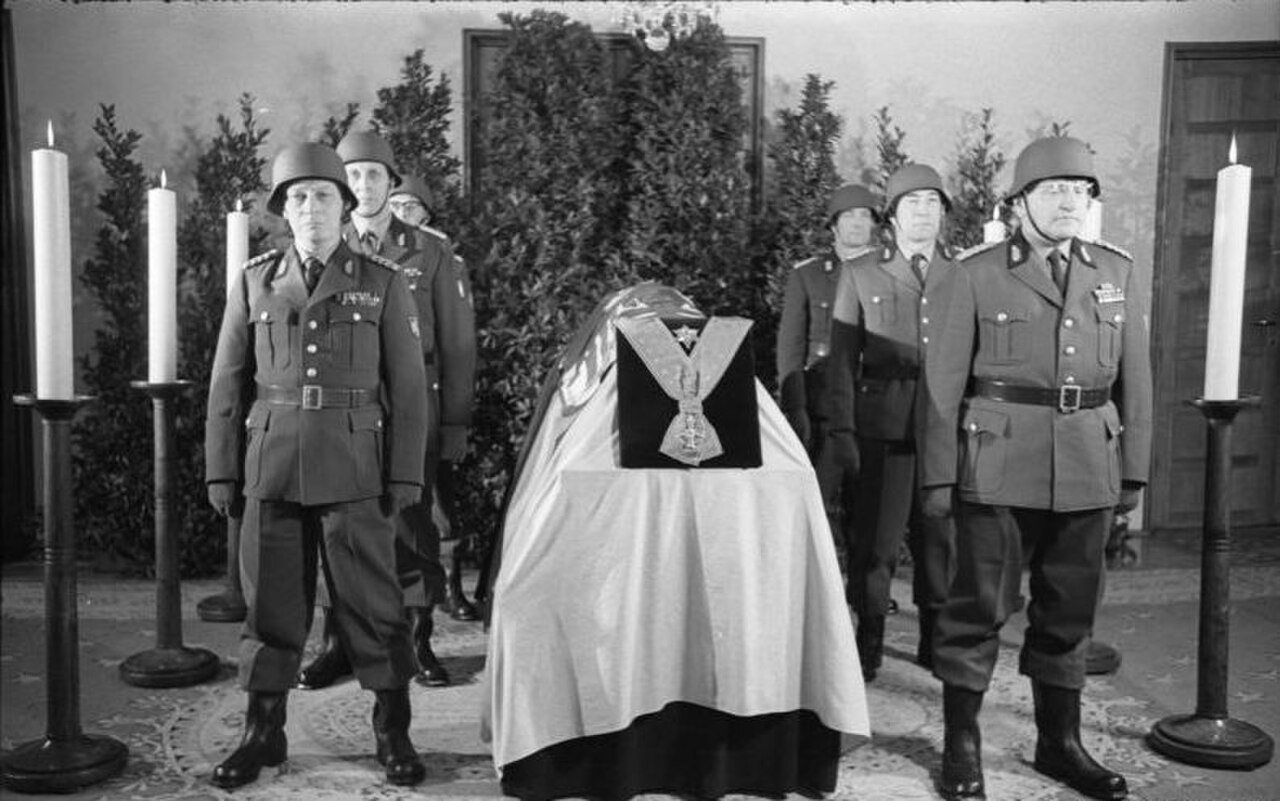
Federal Border Guard personnel guard Adenauer's coffin
Funeral service for Adenauer in Cologne Cathedral
Crowds watch as Adenauer's remains are conveyed along the Rhine
Adenauer on the cover of Time as Man of the Year, 4 January 1954
11 images

In the early years of the Federal Republic, Adenauer shifted attention from denazification to economic recovery and closer ties with France, the United Kingdom and the United States. A strong anti-communist, he backed an Atlanticist foreign policy, helped establish the Bundeswehr and the Bundesnachrichtendienst, and brought West Germany into NATO. He refused to recognise East Germany or the Oder–Neisse line as Poland's frontier, and in 1957 he signed the Treaty of Rome, supporting European unity.

In 115 languages

Редакція Factograf · Published October 14, 2026 · Partly based on Wikipedia, CC BY-SA 4.0 · Source article