factograf
EN
Sign in

tragedy by William Shakespeare

Hamlet

Hamlet

Hamlet is a tragedy by William Shakespeare, written sometime between 1599 and 1601 and the longest of his plays. Set in Denmark, it follows Prince Hamlet as he seeks revenge against his uncle Claudius, who has murdered Hamlet's father to seize the throne and marry Hamlet's mother. The play is widely regarded as one of the greatest works in English literature and has been retold and adapted by others many times.

Textual history

Edwin Booth as Hamlet, 1870
Kronborg Castle, which is portrayed as Elsinore in the play Hamlet
Horatio, Hamlet and the ghost (artist: Henry Fuseli, 1789)
Hamlet mistakenly stabs Polonius (artist: Coke Smyth, 19th century)
The gravedigger scene (artist: Eugène Delacroix, 1839)
A facsimile of Gesta Danorum by Saxo Grammaticus, which contains the legend of Amleth
Title page of The Spanish Tragedy by Thomas Kyd
John Barrymore as Hamlet (1922)
Title page of the 1605 printing (Q2) of Hamlet
The first page of the First Folio printing of Hamlet, 1623
Comparison of the 'To be, or not to be' soliloquy in the first three editions of Hamlet, showing the varying text quality in the Bad Quarto, the Good Quarto and the First Folio
11 images

Three early versions of the play survive: the First Quarto of 1603, the Second Quarto of 1604, and the First Folio of 1623. Each contains lines and passages absent from the others, which has made the question of the authoritative text a long-standing subject of scholarly debate. Many earlier works have been suggested as possible sources, ranging from ancient Greek tragedies to Elizabethan dramas.

Central themes

Hamlet's statement that his dark clothes are the outward sign of his inner grief shows strong rhetorical skill (artist: Eugène Delacroix, 1834)
John Everett Millais's Ophelia (1852) depicts the mysterious drowning death of Lady Ophelia; in the play, the gravediggers debate whether her death was suicide and whether she deserves a Christian burial
Philosophical ideas in Hamlet resemble those of French writer Michel de Montaigne, a contemporary of Shakespeare (artist: Thomas de Leu, fl. 1560–1612)
Ophelia is distracted by grief; feminist critics have explored her descent into madness (artist: Henrietta Rae, 1890)
Hamlet tries to show his mother Gertrude his father's ghost (artist: Nicolai A. Abildgaard, c. 1778)
Actors before Hamlet by Władysław Czachórski (1875), National Museum in Warsaw
Title page and frontispiece for Hamlet, Prince of Denmark: A Tragedy, as acted at the Theatres-Royal in Drury Lane and Covent Garden, London, 1776
David Garrick expresses Hamlet's shock at his first sighting of the ghost (artist unknown)
A poster from c. 1884 for an American production of Hamlet starring Thomas W. Keene, showing several key scenes
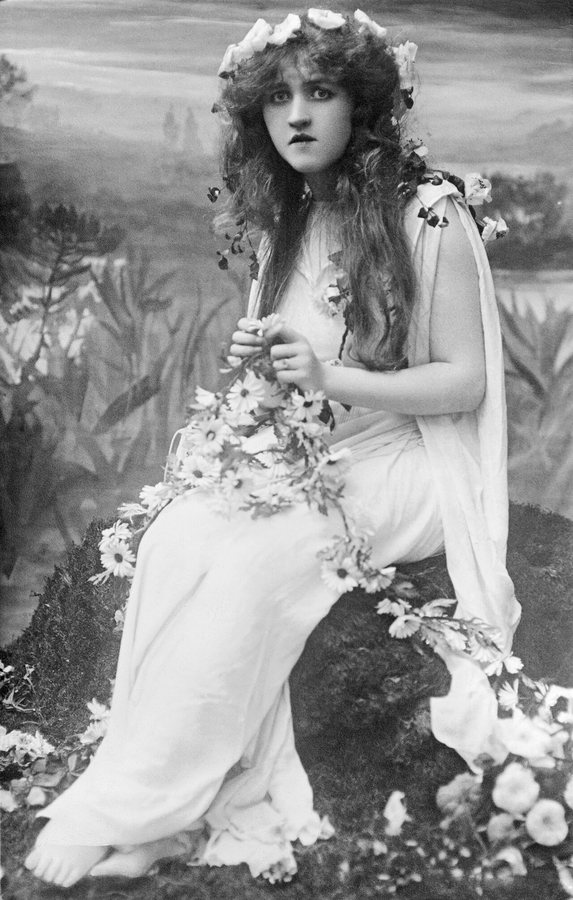
Mignon Nevada as Ophelia, 1910
Scenes from a 1904 benefit performance of W. S. Gilbert's Rosencrantz and Guildenstern, with Gilbert as Claudius
11 images

The story centres on Hamlet's hesitation to act on the ghost's demand for vengeance, his feigned madness, and his uncertainty about the ghost's reliability. Its plot involves a court riddled with spying, a romance that ends in tragedy for Ophelia, and a final duel that leaves much of the royal family dead, with Hamlet naming Fortinbras as his successor.

In 97 languages

Редакція Factograf · Published October 14, 2026 · Partly based on Wikipedia, CC BY-SA 4.0 · Source article