factograf
EN
Sign in

city and capital of the Pomeranian Voivodeship on the Baltic coast of northern Poland

Gdańsk

Gdańsk

Gdańsk is a city on the Baltic coast of northern Poland and the capital of the Pomeranian Voivodeship. It is the country's sixth-largest city and its major seaport. Together with nearby Gdynia and the resort town of Sopot, it forms the Tricity metropolitan area, home to about 1.5 million people. The historic city centre is a national monument, and Gdańsk became a UNESCO City of Literature in 2025.

Early history

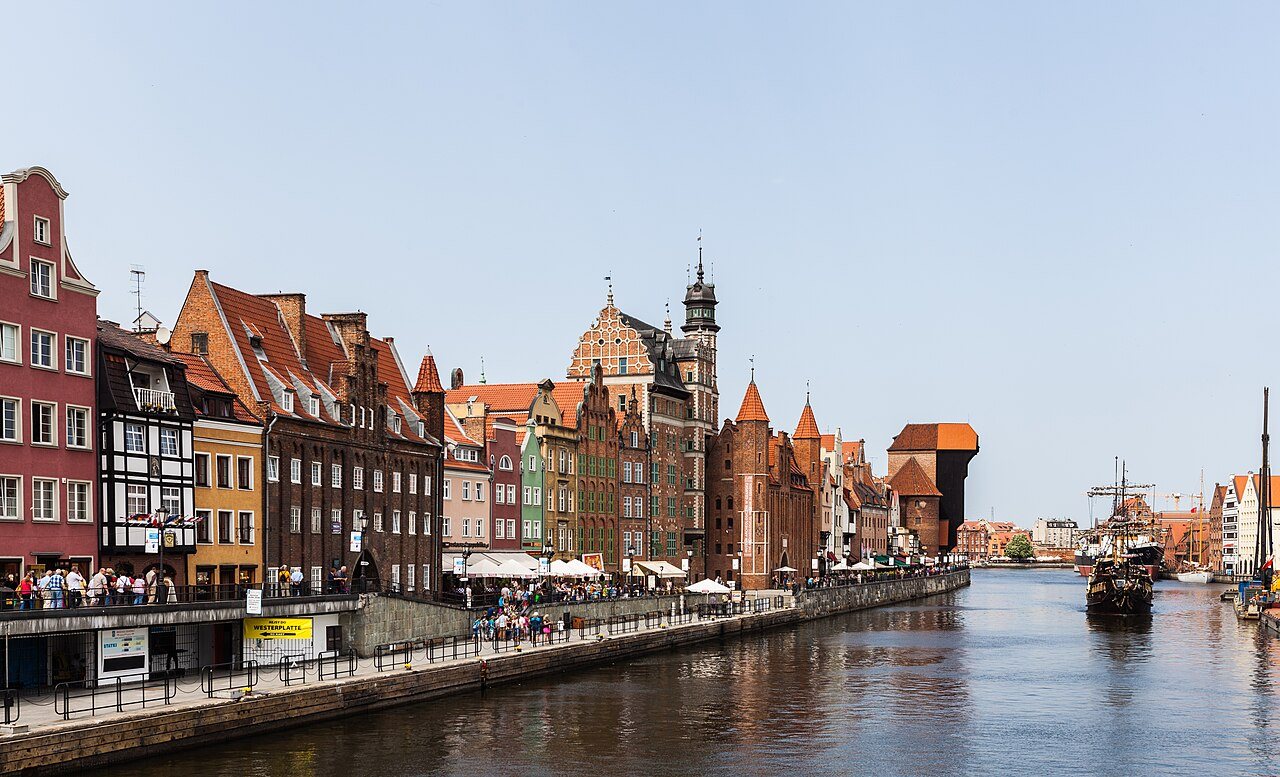
Long Street (Długie Pobrzeże), Gdańsk, Poland, 20 May 2013, view 06
Artus Court, Gdańsk, Poland, 20 May 2013, view 03
Gdańsk, Neptune's Fountain. Photo by Barbara Maliszewska
Great Armoury, Gdańsk, Poland, 20 May 2013, view 08
Gdańsk Main Town Hall, 2015
Museum of the Second World War, view 2
Gdańsk, 2023, photo 106
St. Catherine's Church, Gdańsk, Poland, 20 May 2013, view 01
A manuscript fragment featuring the name Gyddanyzc
Excavated cellars of a 13th-century Dominican monastery in Gdańsk
Gdańsk Crane, the largest medieval port crane, completed in 1444
Original 1455 charter by King Casimir IV granting Danzig the right to independently levy and abolish taxes
12 images

The settlement was first mentioned in 997 as part of the Duchy of Poland, when Saint Adalbert of Prague baptised its inhabitants. It grew into a trading town under the Piast and Samboride dynasties and shifted between Polish and Teutonic control during the Middle Ages. It later joined the Hanseatic League and served as the principal seaport and largest city of the Polish Crown until the early 18th century.

Modern era

Danzig in the 16th century, published by Georg Braun and Frans Hogenberg
Apotheosis of Gdańsk by Isaak van den Blocke. Vistula trade was the main source of prosperity in the city's Golden Age.
Allegory of wealth from 1604, showing affluent citizens in the foreground and the city with its landmarks, including the Torture Tower and Main Town Hall, behind them
Groschen coins minted in the Free City of Danzig after Napoleon's entry, following the 1807 Franco-Polish siege
Early photograph of Langgasse, today Długa Street, 1855
Aerial view of the historic city centre around 1920
German battleship SMS Schleswig-Holstein firing at the Polish Military Transit Depot at Westerplatte during the Battle of Westerplatte, September 1939
Crowds greet Adolf Hitler as he rides in an open car in Danzig, September 1939
Solidarity strikes at the Gdańsk Shipyard, 1980
The European Solidarity Centre houses exhibits on the Solidarity trade union and the anti-communist resistance in Poland
Gdańsk Shipyard
Gdańsk Shipyard
Panoramic view of Gdańsk, 30 August 2012
12 images

After the Partitions of Poland, the city was annexed by Prussia in 1793 and became part of the German Empire in 1871. It was a free city from 1807 to 1814 and again from 1920 to 1939. The Battle of Westerplatte, one of the first events of World War II, took place there on 1 September 1939. In the 1980s the city was the birthplace of the Solidarity trade union and movement.

Culture and tourism

Upper Gate, Gdańsk, Poland, 20 May 2013, view 02
Golden Gate, Gdańsk
Golden Gate, Gdańsk
Main Town Hall, Gdańsk, Poland, 20 May 2013, view 01
Artus Court, Gdańsk
Artus Court, Gdańsk
Golden Tenement House, Gdańsk
Neptune Monument, Gdańsk, Poland, 20 May 2013, view 05
Museum of the Polish Post Office, dedicated to the defence of the Polish Post Office in the Free City during the interwar period, 1920–1939
Gdańsk Lech Wałęsa Airport, 2012, before the 2022 expansion
Gdańsk Główny railway station
Municipal Stadium, Gdańsk
Gdańsk University of Technology
11 images

Gdańsk hosts the University of Gdańsk, Gdańsk University of Technology, the European Solidarity Centre and the Museum of the Second World War. Its landmarks include the Town Hall, the Green Gate and St. Mary's Church, one of the largest brick churches in the world. The city received 4.5 million tourists in 2024 and hosts St. Dominic's Fair, which dates back to 1260.

In 141 languages

Редакція Factograf · Published October 14, 2026 · Partly based on Wikipedia, CC BY-SA 4.0 · Source article