Gene
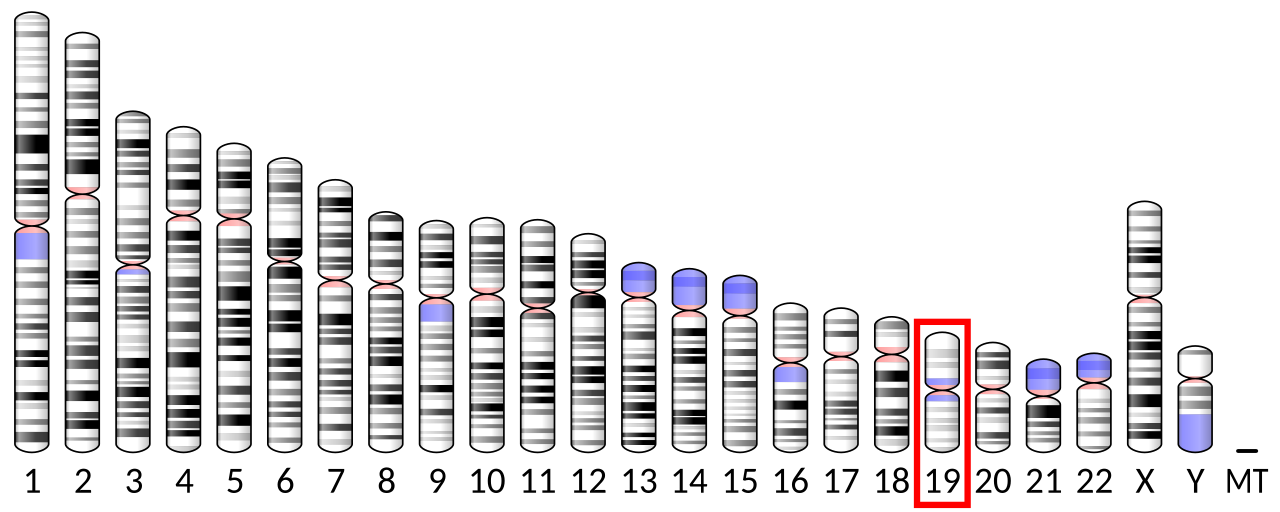
The human GIPC3 gene is located on the short arm of chromosome 19 at p13.3. The locus extends over about 8 kbp and contains the six coding exons that give rise to an open reading frame of 639 nucleotides encoding the GIPC3 protein of 312 amino acids. In the mouse, Gipc3 is located on chromosome 10 at cytogenetic band qC1. The genomic region covers a distance of 5.5 kbp. The six coding exons encode a protein of 297 amino acids. The PDZ domain is located at amino acid position 107-174.
Structure
GIPC3, features a centrally located PDZ domain, which is flanked on each side by a single GIPC-homology domain.
The single PDZ domain is located at amino acid position 122-189.
Function
GIPC3 is thought to be important for acoustic signal acquisition and propagation in hair cells of the mammalian cochlea.
Clinical signficance
In humans, individuals with the p.W301X missense mutation (DFNB95) exhibit bilateral sensorineural hearing loss with threshold shifts of 70-80 dB hearing levels as early as 11 months of age.
Animal studies
In the mouse, a missense mutation in Gipc3 (c.343G>A) leads to a non-synonymous amino acid replacement (p.G115R) in the loop connecting two beta strands of the PDZ domain. Glycine 115 is conserved in all GIPC proteins. Missense (c.785C>T; p. L262R) and nonsense (c.903G>A, p.W301X) mutations in human GIPC3 cause congenital sensorineural hearing impairment in families segregating non-syndromic hearing loss DFNB15 and DFNB95.
Mice of the Black Swiss strain develop early-onset slowly progressing sensorineural hearing loss. A genetic study identified two quantitative trait loci (QTL) that control hearing function. One QTL, named age-related hearing loss 5 (ahl5) localizes to chromosome 10 and accounted for ca. 60% of the variation in hearing thresholds. A second QTL, ahl6, localized to chromosome 18 and has a smaller effect size. Besides their hearing impairment, Black Swiss mice also are hypersensitive to acoustic stimulation, reacting with seizures (audiogenic seizures) to loud white noise. A genetic locus conferring susceptibility was identified (juvenile audiogenic monogenic seizures1, jams1) on chromosome 10. A positional cloning approach aimed to decipher the genetic basis of both the hearing loss and audiogenic seizure susceptibility subsequently identified the glycine to arginine substitution in Gipc3 as the underlying cause.
Interactions
The PDZ domain of GIPC family proteins interact with:


