In algebra, flat modules include free modules, projective modules, and, over a principal ideal domain, torsion-free modules. Formally, a module M over a ring R is flat if taking the tensor product over R with M preserves exact sequences. A module is faithfully flat if taking the tensor product with a sequence produces an exact sequence if and only if the original sequence is exact.
Flatness was introduced by Jean-Pierre Serre (1956) in his paper Géometrie Algébrique et Géométrie Analytique.
Definition
A left module M over a ring R is flat if the following condition is satisfied: for every injective linear map 

is also injective, where 

For this definition, it is enough to restrict the injections 
Equivalently, an R-module M is flat if the tensor product with M is an exact functor; that is if, for every short exact sequence of R-modules 

These definitions apply also if R is a non-commutative ring, and M is a left R-module; in this case, K, L and J must be right R-modules, and the tensor products are not R-modules in general, but only abelian groups.
Characterizations
Flatness can also be characterized by the following equational condition, which means that R-linear relations in M stem from linear relations in R.
A left R-module M is flat if and only if, for every linear relation
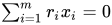
with 


for
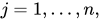
and
for

It is equivalent to define n elements of a module, and a linear map from 
An R-module M is flat if and only if the following condition holds: for every map 


Relations to other module properties

Flatness is related to various other module properties, such as being free, projective, or torsion-free. In particular, every flat module is torsion-free, every projective module is flat, and every free module is projective.
There are finitely generated modules that are flat and not projective. However, finitely generated flat modules are all projective over the rings that are most commonly considered. Moreover, a finitely generated module is flat if and only it is locally free, meaning all the localizations at prime ideals are free modules.
This is partly summarized in the following graphic.
Torsion-free modules
Every flat module is torsion-free. This results from the above characterization in terms of relations by taking m = 1.
The converse holds over the integers, and more generally over principal ideal domains and Dedekind rings.
An integral domain over which every torsion-free module is flat is called a Prüfer domain.
Free and projective modules
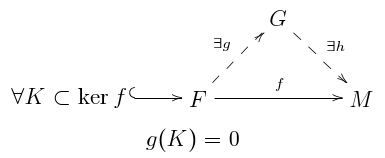
A module M is projective if and only if there is a free module G and two linear maps 


Every projective module is flat. This can be proven from the above characterizations of flatness and projectivity in terms of linear maps by taking 

Conversely, finitely generated flat modules are projective under mild conditions that are generally satisfied in commutative algebra and algebraic geometry. This makes the concept of flatness useful mainly for modules that are not finitely generated.
A finitely presented module (that is the quotient of a finitely generated free module by a finitely generated submodule) that is flat is always projective. This can be proven by taking f surjective and 




Over a Noetherian ring, every finitely generated flat module is projective, since every finitely generated module is finitely presented. The same result is true over an integral domain, even if it is not Noetherian.
On a local ring every finitely generated flat module is free.
A finitely generated flat module that is not projective can be built as follows. Let 

Non-examples
- If I is an ideal in a Noetherian commutative ring R, then
is not a flat module, except if I is generated by an idempotent (that is an element equal to its square). In particular, if R is an integral domain,
equals R or is the zero ideal.
- Over an integral domain, a flat module is torsion free. Thus a module that contains nonzero torsion elements is not flat. In particular
and all fields of positive characteristics are non-flat
-modules, where
is the field of the rational numbers.
Direct sums, limits and products
The direct sum 

The direct limit of flat modules is flat. In particular, the direct limit of free modules is flat. Conversely, every flat module can be written as the direct limit of finitely-generated free modules.
Direct products of flat modules need not in general be flat. In fact, given a ring R, every direct product of flat R-modules is flat if and only if R is a coherent ring (that is, every finitely generated ideal is finitely presented).
Flat ring extensions
A ring homomorphism 
For any multiplicative subset 


If 


Local property
In this section, R denotes a commutative ring. If 


If M is an R-module the three following conditions are equivalent:
is a flat
is a flat
-module for every prime ideal
is a flat
-module for every maximal ideal


This property is fundamental in commutative algebra and algebraic geometry, since it reduces the study of flatness to the case of local rings. They are often expressed by saying that flatness is a local property.
Flat morphisms of schemes
The definition of a flat morphism of schemes results immediately from the local property of flatness.
A morphism 

is a flat ring homomorphism for any point x in X.
Thus, properties of flat (or faithfully flat) ring homomorphisms extend naturally to geometric properties of flat morphisms in algebraic geometry.
For example, consider the flat ![{\displaystyle \mathbb {C} [t]}](https://wikimedia.org/api/rest_v1/media/math/render/svg/d83161b277d877a8dd4ad77c9884af86de11c2e4)
![{\displaystyle R=\mathbb {C} [t,x,y]/(xy-t)}](https://wikimedia.org/api/rest_v1/media/math/render/svg/3f79d023d7cdf8e4bdb742ecb2b9c7d7903d1060)
![{\displaystyle \mathbb {C} [t]\hookrightarrow R}](https://wikimedia.org/api/rest_v1/media/math/render/svg/2d9fd115e5bf386bb4e0c69d5aeab83cd38d876e)
![{\displaystyle \pi:\operatorname {Spec} (R)\to \operatorname {Spec} (\mathbb {C} [t]).}](https://wikimedia.org/api/rest_v1/media/math/render/svg/1b076bd46405a1a8f543594234291686a55b5529)
The (geometric) fiber 

Let ![{\displaystyle S=R[x_{1},\dots,x_{r}]}](https://wikimedia.org/api/rest_v1/media/math/render/svg/c6e65c3af29ebe78c3d4381fea16f5a939b419e8)


![{\displaystyle \mathbb {C} [t,x,y]/(xy-t),}](https://wikimedia.org/api/rest_v1/media/math/render/svg/1d5fd7b6e89cf6b9acfc62c69b2f3d82d1ce8785)
Faithful flatness
A module is faithfully flat if taking the tensor product with a sequence produces an exact sequence if and only if the original sequence is exact. Although the concept is defined for modules over a non-necessary commutative ring, it is used mainly for commutative algebras. So, this is the only case that is considered here, even if some results can be generalized to the case of modules over a non-commutative ring.
In this section, 
If
- For each maximal ideal
of
- If
- For every prime ideal
of
In other words, the map
induced by
is injective, and
that is,
is injective for every

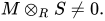
The second condition implies that a flat local homomorphism of local rings is faithfully flat. It follows from the last condition that 

The second-last condition can be stated in the following strengthened form: 


Examples
- A ring homomorphism
- Every field extension is faithfully flat. This property is implicitly behind the use of complexification for proving results on real vector spaces.
- A polynomial ring is a faithfully flat extension of its ring of coefficients.
- If
is a monic polynomial, the inclusion
is faithfully flat.
- Let
The direct product
of the localizations at the
is faithfully flat over
generate the unit ideal of
is a linear combination of the
- The direct sum of the localizations
The two last examples are implicitly behind the wide use of localization in commutative algebra and algebraic geometry.
- For a given ring homomorphism
there is an associated complex called the Amitsur complex:



Faithfully flat local homomorphisms
Here is one characterization of a faithfully flat homomorphism for a not-necessarily-flat homomorphism. Given an injective local homomorphism 



Homological characterization using Tor functors
Flatness may also be expressed using the Tor functors, the left derived functors of the tensor product. A left
for all
and all right
).
In fact, it is enough to check that the first Tor term vanishes, i.e., M is flat if and only if

for any 


Using the Tor functor's long exact sequences, one can then easily prove facts about a short exact sequence

If 


Flat resolutions
A flat resolution of a module

where the 
The length of a finite flat resolution is the first subscript n such that 



In some areas of module theory, a flat resolution must satisfy the additional requirement that each map is a flat pre-cover of the kernel of the map to the right. For projective resolutions, this condition is almost invisible: a projective pre-cover is simply an epimorphism from a projective module. These ideas are inspired from Auslander's work in approximations. These ideas are also familiar from the more common notion of minimal projective resolutions, where each map is required to be a projective cover of the kernel of the map to the right. However, projective covers need not exist in general, so minimal projective resolutions are only of limited use over rings like the integers.
Flat covers
While projective covers for modules do not always exist, it was speculated that for general rings, every module would have a flat cover, that is, every module M would be the epimorphic image of a flat module F such that every map from a flat module onto M factors through F, and any endomorphism of F over M is an automorphism. This flat cover conjecture was explicitly first stated in Enochs (1981, p. 196). The conjecture turned out to be true, resolved positively and proved simultaneously by L. Bican, R. El Bashir and E. Enochs. This was preceded by important contributions by P. Eklof, J. Trlifaj and J. Xu.
Since flat covers exist for all modules over all rings, minimal flat resolutions can take the place of minimal projective resolutions in many circumstances. The measurement of the departure of flat resolutions from projective resolutions is called relative homological algebra, and is covered in classics such as Mac Lane (1963) and in more recent works focussing on flat resolutions such as Enochs and Jenda (2000).
In constructive mathematics
Flat modules have increased importance in constructive mathematics, where projective modules are less useful. For example, that all free modules are projective is equivalent to the full axiom of choice, so theorems about projective modules, even if proved constructively, do not necessarily apply to free modules. In contrast, no choice is needed to prove that free modules are flat, so theorems about flat modules can still apply.