In mathematics, the Tor functors are the derived functors of the tensor product of modules over a ring. Along with the Ext functor, Tor is one of the central concepts of homological algebra, in which ideas from algebraic topology are used to construct invariants of algebraic structures. The homology of groups, Lie algebras, and associative algebras can all be defined in terms of Tor. The name comes from a relation between the first Tor group Tor1 and the torsion subgroup of an abelian group.
In the special case of abelian groups, Tor was introduced by Eduard Čech in 1935 and named by Samuel Eilenberg around 1950. It was first applied to the Künneth theorem and universal coefficient theorem in topology. For modules over any ring, Ext was defined by Henri Cartan and Eilenberg in 1956.
Definition
Let 







For each integer 



Alternatively, one can define 

For a commutative ring 
Properties
Here are some of the basic properties and computations of Tor groups.
for any right
for all
if either
- If
are finitely generated abelian groups, then
, where
is the torsion subgroup of
- There are converses to the previous statement:
- If
for all
- If
- If
- By the general properties of derived functors, every short exact sequence
of right
for any left
- Symmetry: for a commutative ring
. (For
- If
in
where
is the
of integers, this calculation can be used to compute
for any finitely generated abelian group
- Generalizing the previous example, one can compute Tor groups that involve the quotient of a commutative ring by any regular sequence, using the Koszul complex. For example, if
over a field
, then
is the exterior algebra over
generators in
.
for all
. The reason: every abelian group
- Generalizing the previous example,
for all
- For any ring
- Flat base change: for a commutative flat
,
It follows that Tor commutes with localization. That is, for a multiplicatively closed set
- For a commutative ring
has the structure of a graded-commutative algebra over
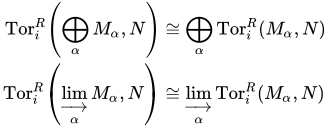

Important special cases
- Group homology is defined by
where G is a group, M is a representation of G over the integers, and
is the group ring of G.
- For an algebra A over a field k and an A-bimodule M, Hochschild homology is defined by
- Lie algebra homology is defined by
, where
is a Lie algebra over a commutative ring R, M is a
is the universal enveloping algebra.
- For a commutative ring R with a homomorphism onto a field k,
R(k,k).) As an algebra,

See also
- Flat morphism
- Serre's intersection formula
- Derived tensor product
- Eilenberg–Moore spectral sequence
Notes
References
- Avramov, Luchezar; Halperin, Stephen (1986), "Through the looking glass: a dictionary between rational homotopy theory and local algebra", in J.-E. Roos (ed.), Algebra, algebraic topology, and their interactions (Stockholm, 1983), Lecture Notes in Mathematics, vol. 1183, Springer Nature, pp. 1–27, doi:10.1007/BFb0075446, ISBN 978-3-540-16453-1, MR 0846435
- Cartan, Henri; Eilenberg, Samuel (1999) [1956], Homological algebra, Princeton: Princeton University Press, ISBN 0-691-04991-2, MR 0077480
- Čech, Eduard (1935), "Les groupes de Betti d'un complexe infini" (PDF), Fundamenta Mathematicae, 25: 33–44, doi:10.4064/fm-25-1-33-44, JFM 61.0609.02
- Gulliksen, Tor; Levin, Gerson (1969), Homology of local rings, Queen's Papers in Pure and Applied Mathematics, vol. 20, Queen's University, MR 0262227
- Quillen, Daniel (1970), "On the (co-)homology of commutative rings", Applications of categorical algebra, Proc. Symp. Pure Mat., vol. 17, American Mathematical Society, pp. 65–87, MR 0257068
- Sjödin, Gunnar (1980), "Hopf algebras and derivations", Journal of Algebra, 64: 218–229, doi:10.1016/0021-8693(80)90143-X, MR 0575792
- Weibel, Charles A. (1994), An introduction to homological algebra, Cambridge Studies in Advanced Mathematics, vol. 38, Cambridge University Press, ISBN 978-0-521-55987-4, MR 1269324, OCLC 36131259
- Weibel, Charles (1999), "History of homological algebra", History of topology (PDF), Amsterdam: North-Holland, pp. 797–836, MR 1721123
External links
- The Stacks Project Authors, The Stacks Project
