Fergusonite is a mineral comprising a complex oxide of various rare-earth elements. The general chemical formula of fergusonite is (Y,REE)NbO4, where REE = rare-earth elements in solid solution with Y. Yttrium is usually dominant (the mineral in this case being referred to as fergusonite-(Y)), but sometimes Ce or Nd may be the major rare-earth component (in fergusonite-(Ce) and fergusonite-(Nd), respectively). The other rare-earth elements are present in smaller amounts, and tantalum sometimes substitutes for some of the niobium. There are fergusonite-beta-(Nd), fergusonite-beta-(Y), fergusonite-beta-(Ce) forms too, but they are classified as 4.DG.10 in the Nickel–Strunz system. The mineral has tetragonal crystal symmetry and the same structure as scheelite (calcium tungstate, CaWO4), but can be metamict (amorphous) due to radiation damage from its small content of thorium. It is found as needle-like or prismatic crystals in pegmatite. It was named after British politician and mineral collector Robert Ferguson of Raith (1767–1840).
Sulfate mineral series
Fergusonite
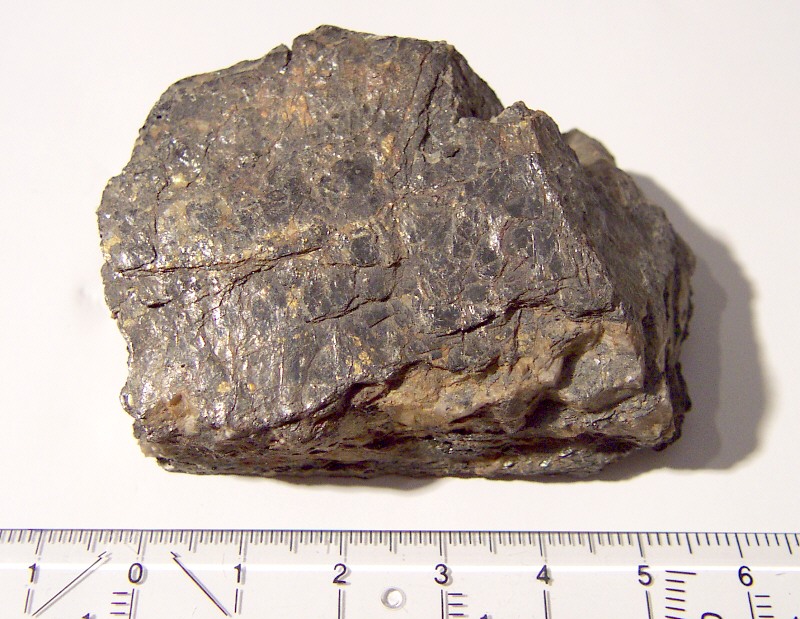
All data from the card 18
- Category
- Oxide minerals
- Formula
- REENbO4 (REE: rare-earth element)
- IMA symbol
- Fgs
- Strunz classification
- 7.GA.05
- Crystal system
- Tetragonal
- Crystal class
- Dipyramidal (4/m) H-M symbol: (4/m)
- Space group
- I41/a
- Formula mass
- 245.81 g/mol (Y)
- Color
- Black, black, brown, gray, yellow
- Crystal habit
- Metamict – mineral originally crystalline, now amorphous due to radiation damage
- Cleavage
- Indistinct
- Fracture
- Subconchoidal – fractures developed in brittle materials characterized by semi-curving surfaces
- Mohs scale hardness
- 5.5–6
- Luster
- Submetallic
- Streak
- Brown
- Density
- 4.3–5.8, average = 5.05
- Refractive index
- 2.05–2.19, isotropic
- Other characteristics
- Nonmagnetic, non-fluorescent, non-radioactive
Read next


In 14 languages
Text from Wikipedia, CC BY-SA 4.0 · Source article