Bangladesh, officially the People's Republic of Bangladesh, is a country in South Asia with a population of almost 175.4 million. It is the eighth-most populous country in the world, covering 148,461 square kilometres. It borders India and Myanmar and has a coastline on the Bay of Bengal. Dhaka is the capital and largest city, serving as the nation's political, financial and cultural centre, while Chittagong is the second-largest city and the busiest port.
Colonial and Partition era
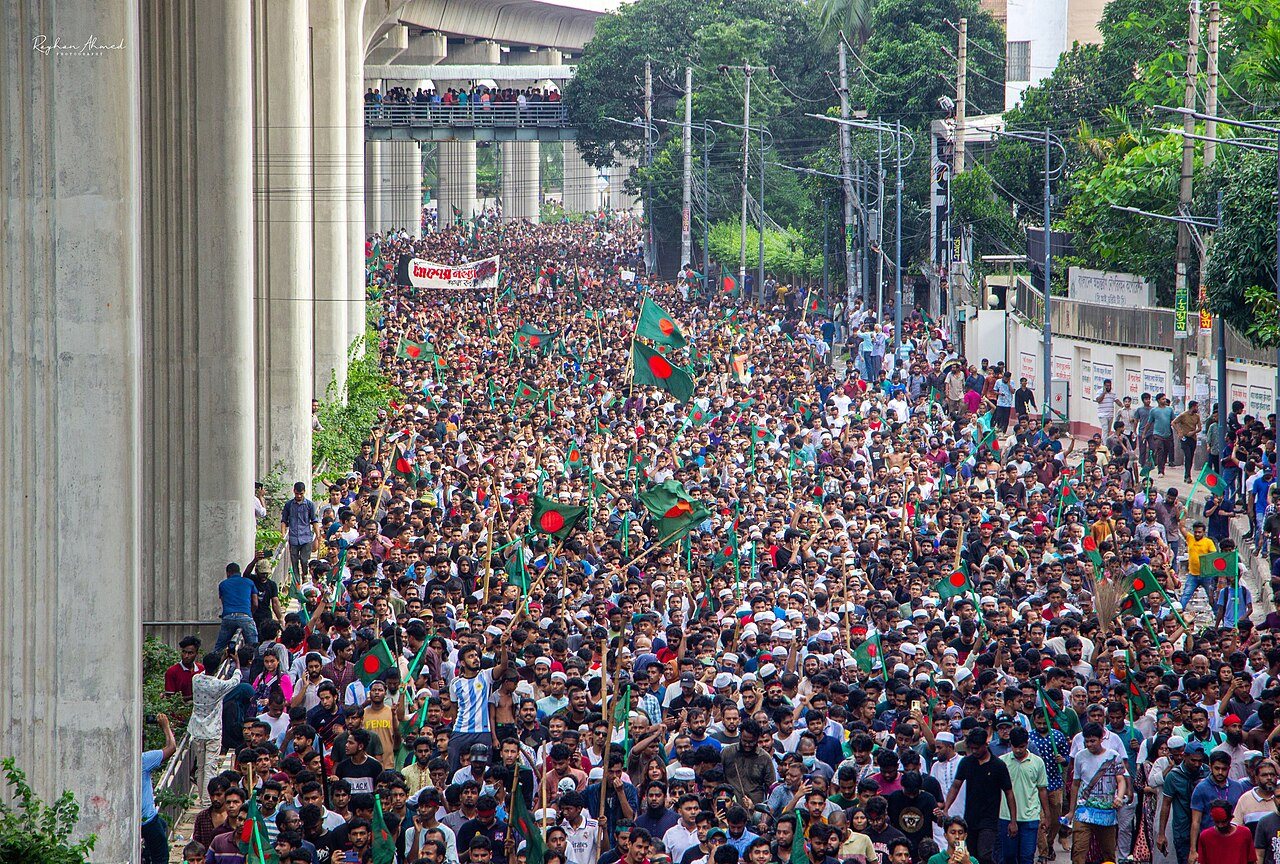
A woman in Dhaka wearing fine Bengali muslin, 18th centuryLegend: Bengal Presidency in one color, British India in anotherStudents marching on the University of Dhaka campus during the mass protests and riots of 1969Victory march by protesters after the resignation of Sheikh Hasina in 2024Satellite photo from space showing pollution over BangladeshFlooding after the 1991 Bangladesh cyclone, which killed around 140,000 peopleA Bengal tiger, the national animal, in the SundarbansMirza Fakhrul Islam Alamgir, 2026Tarique Rahman at a meeting on farmer cards, Cabinet Division, Secretariat, Dhaka, 23 February 2026, croppedNational Assembly of BangladeshBangabhaban, the official residence of the President of BangladeshBangladeshi soldiers on a BTR-80 armoured personnel carrier
12 images
The territory was ruled by successive Hindu and Buddhist dynasties before Muslim conquest in 1204 brought Sultanate and Mughal rule. Bengal later became a major centre of textiles and agriculture. After the Battle of Plassey in 1757, British colonial rule lasted nearly two centuries, drawing wealth away from the region and bringing repeated famines. After the Partition of India in 1947, the eastern part of Bengal joined Pakistan as East Pakistan.
Independence and modern state
Baitul Mukarram National Mosque, the largest and national mosque of BangladeshNorthern facade of Curzon Hall, University of Dhaka, 2015Chart of life expectancy in Bangladesh by the World Bank GroupChart of child mortality rate in BangladeshA community health worker conducting a survey in the Korail slum, DhakaVictory Day celebration at the National Martyrs' MemorialPortrait of poet Kazi Nazrul IslamPortrait of writer Humayun AhmedPaharpur Buddhist Vihara, a Buddhist monastery ruinSixty Dome Mosque in BagerhatFront view of Ahsan Manzil, a palace in DhakaKantha quilt, a traditional embroidered textile
12 images
Growing unrest in East Pakistan over political and economic marginalisation led to the Bangladesh Liberation War, after which the country became a sovereign nation on 16 December 1971. Political life since then has been shaped by assassinations, military dictatorship and a return to parliamentary democracy in 1991. Today Bangladesh is a unitary parliamentary republic with South Asia's second-largest economy, and it is home to the world's largest mangrove forest, the Sundarbans.