factograf
EN
Sign in

greek mythological hero of the Trojan War

Achilles

Achilles

Achilles was a hero of the Trojan War in Greek mythology, known as the greatest of all the Greek warriors. He is the central character in Homer's Iliad and was the son of the Nereid Thetis and Peleus, king of Phthia. Raised in Phthia alongside his companion Patroclus, he was educated by the centaur Chiron and was presented as the commander of the Myrmidons. His name and story have shaped a common phrase, Achilles' heel, used for a point of weakness that can lead to downfall.

Most notable feat

Achilles fighting against Memnon, Leiden Rijksmuseum voor Oudheden
Thetis Dipping the Infant Achilles into the River Styx by Peter Paul Rubens (c. 1625; Museum Boijmans Van Beuningen, Rotterdam)
The Education of Achilles, by Eugène Delacroix, pastel on paper, c. 1862 (Getty Center, Los Angeles)
The Education of Achilles (c. 1772), by James Barry (Yale Center for British Art)
Chiron teaching Achilles how to play the lyre, Roman fresco from Herculaneum, first century AD
A Roman mosaic from the Poseidon Villa in Zeugma, Commagene (now in the Zeugma Mosaic Museum) depicting Achilles disguised as a woman and Odysseus tricking him into revealing himself
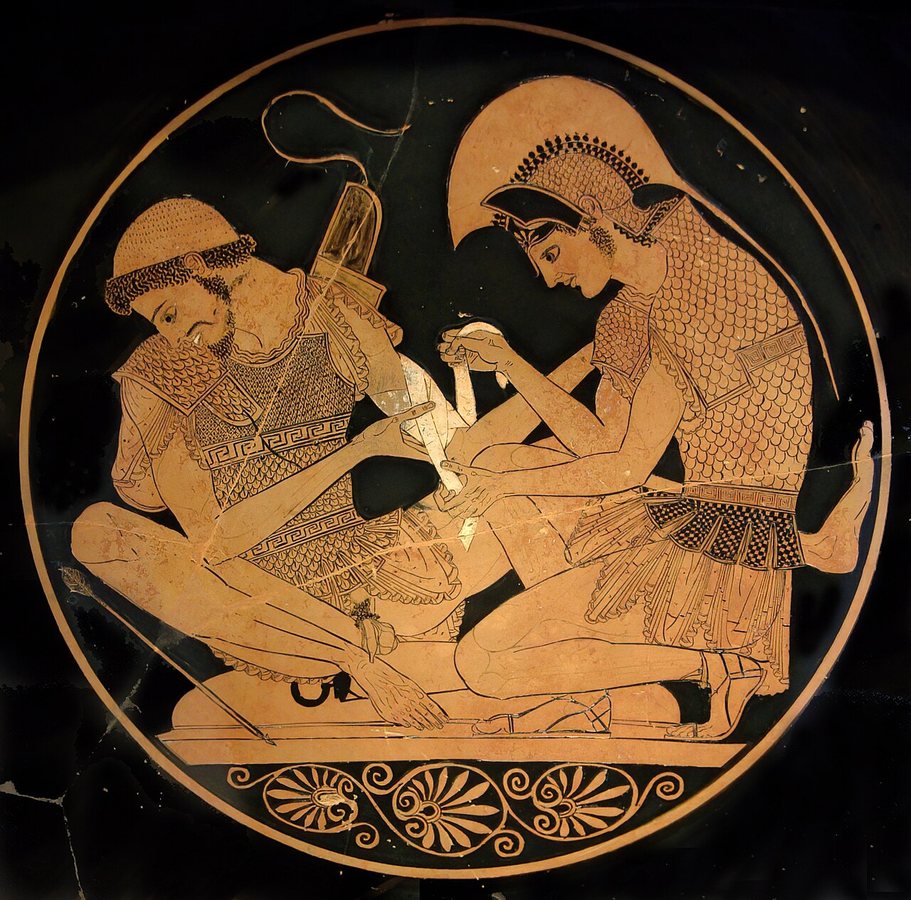
Akhilleus Patroklos, Antikensammlung Berlin F2278
A marble representation of Achilles at the court of King Lycomedes, c. 240 AD
Achilles slaying Troilus, red-figure kylix signed by Euphronios
Achilles and Agamemnon, from a mosaic from Pompeii, first century AD
Achilles cedes Briseis to Agamemnon, from the House of the Tragic Poet in Pompeii, fresco, first century AD (Naples National Archaeological Museum)
The Rage of Achilles, fresco by Giovanni Battista Tiepolo (1757, Villa Valmarana ai Nani, Vicenza)
12 images

Achilles's most notable feat in the Trojan War was the slaying of the Trojan prince Hector outside the gates of Troy. The Iliad does not describe his death, but other sources agree that he was killed near the end of the war by Paris, who shot him with an arrow. Later legends, beginning with Statius's unfinished epic Achilleid, claimed that he was invulnerable except for one heel, which his mother held when she dipped him in the river Styx as an infant.

Name and origins

Roman statue of a man with the dead body of a boy, identified as Achilles and Troilus, second century AD (Naples National Archaeological Museum)
Mosaic of the Oecus, Achilles on Skyros
Achilles at Skyros, mosaic, Villa La Olmeda, 4th century AD
Briseis and Achilles, engraving by Wenceslaus Hollar (1607–1677)
The Wrath of Achilles (c. 1630–1635), painting by Peter Paul Rubens
The Death of Hector, unfinished oil painting by Peter Paul Rubens
Achilles and Agamemnon by Gottlieb Schick (1801)
Wellington Monument Achilles, geograph.org.uk
Achilles statue, Greece, panoramio
Achilles departure, Eretria Painter, Cabinet des Médailles, Paris
Akhilleus embassy, Staatliche Antikensammlungen 8770
Achilles illustration from the Ambrosian Iliad
12 images

The name Achilleus appears in Linear B tablets and may combine words meaning distress and people, a meaning that ironically contrasts with his fame for glory in war. Some scholars think the name may be a loan word from a pre-Greek language. His descent from the Nereid Thetis and the resemblance of his name to those of river deities have led some researchers to speculate that he was once an old water divinity.

In 102 languages

Редакція Factograf · Published October 14, 2026 · Partly based on Wikipedia, CC BY-SA 4.0 · Source article