factograf
EN
Sign in

Algebra where division is always defined

Wheel theory

Wheel theory

A wheel is a type of algebra (in the sense of universal algebra) where division is always defined. In particular, division by zero is meaningful. The real numbers can be extended to a wheel, as can any commutative ring.

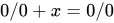
The term wheel is inspired by the topological picture {\displaystyle \odot } of the real projective line together with an extra point ⊥ (bottom element) such that {\displaystyle \bot =0/0}.

A wheel can be regarded as the equivalent of a commutative ring (and semiring) where addition and multiplication are not a group but respectively a commutative monoid and a commutative monoid with involution.

Definition

A wheel is an algebraic structure {\displaystyle (W,0,1,+,\cdot,/)}, in which

and satisfying the following properties:

Algebra of wheels

Wheels replace the usual division as a binary operation with multiplication, with a unary operation applied to one argument {\displaystyle /x} similar (but not identical) to the multiplicative inverse {\displaystyle x^{-1}}, such that {\displaystyle a/b} becomes shorthand for {\displaystyle a\cdot /b=/b\cdot a}, but neither {\displaystyle a\cdot b^{-1}} nor {\displaystyle b^{-1}\cdot a} in general, and modifies the rules of algebra such that

Other identities that may be derived are

  • {\displaystyle 0x+0y=0xy}
  • {\displaystyle x/x=1+0x/x}
  • {\displaystyle x-x=0x^{2}}

where the negation {\displaystyle -x} is defined by {\displaystyle -x=ax} and {\displaystyle x-y=x+(-y)} if there is an element {\displaystyle a} such that {\displaystyle 1+a=0} (thus in the general case {\displaystyle x-x\neq 0}).

However, for values of {\displaystyle x} satisfying {\displaystyle 0x=0} and {\displaystyle 0/x=0}, we get the usual

  • {\displaystyle x/x=1}
  • {\displaystyle x-x=0}

If negation can be defined as above then the subset {\displaystyle \{x\mid 0x=0\}} is a commutative ring, and every commutative ring is such a subset of a wheel. If {\displaystyle x} is an invertible element of the commutative ring then {\displaystyle x^{-1}=/x}. Thus, whenever {\displaystyle x^{-1}} makes sense, it is equal to {\displaystyle /x}, but the latter is always defined, even when {\displaystyle x=0}.

Examples

Wheel of fractions

Let {\displaystyle A} be a commutative ring, and let {\displaystyle S} be a multiplicative submonoid of {\displaystyle A}. Define the congruence relation {\displaystyle \sim _{S}} on {\displaystyle A\times A} via

{\displaystyle (x_{1},x_{2})\sim _{S}(y_{1},y_{2})} means that there exist {\displaystyle s_{x},s_{y}\in S} such that {\displaystyle (s_{x}x_{1},s_{x}x_{2})=(s_{y}y_{1},s_{y}y_{2})}.

Define the wheel of fractions of {\displaystyle A} with respect to {\displaystyle S} as the quotient {\displaystyle A\times A~/{\sim _{S}}} (and denoting the equivalence class containing {\displaystyle (x_{1},x_{2})} as {\displaystyle [x_{1},x_{2}]}) with the operations

{\displaystyle 0=[0_{A},1_{A}]}           (additive identity)
{\displaystyle 1=[1_{A},1_{A}]}           (multiplicative identity)
{\displaystyle /[x_{1},x_{2}]=[x_{2},x_{1}]}           (reciprocal operation)
{\displaystyle [x_{1},x_{2}]+[y_{1},y_{2}]=[x_{1}y_{2}+x_{2}y_{1},x_{2}y_{2}]}           (addition operation)
{\displaystyle [x_{1},x_{2}]\cdot [y_{1},y_{2}]=[x_{1}y_{1},x_{2}y_{2}]}           (multiplication operation)

In general, this structure is not a ring unless it is trivial, as {\displaystyle 0x\neq 0} in the usual sense – here with {\displaystyle x=[0,0]} we get {\displaystyle 0x=[0,0]}, although that implies that {\displaystyle \sim _{S}} is an improper relation on our wheel {\displaystyle W}.

This follows from the fact that {\displaystyle [0,0]=[0,1]\implies 0\in S}, which is also not true in general.

Projective line and Riemann sphere

The special case of the above starting with a field produces a projective line extended to a wheel by adjoining a bottom element noted ⊥, where {\displaystyle 0/0=\bot }. The projective line is itself an extension of the original field by an element {\displaystyle \infty }, where {\displaystyle z/0=\infty } for any element {\displaystyle z\neq 0} in the field. However, {\displaystyle 0/0} is still undefined on the projective line, but is defined in its extension to a wheel.

Starting with the real numbers, the corresponding projective "line" is geometrically a circle, and then the extra point {\displaystyle 0/0} gives the shape that is the source of the term "wheel". Or starting with the complex numbers instead, the corresponding projective "line" is a sphere (the Riemann sphere), and then the extra point gives a 3-dimensional version of a wheel.

Read next

In 9 languages

Text from Wikipedia, CC BY-SA 4.0 · Source article