
A weighted catenary (also flattened catenary, was defined by William Rankine as transformed catenary and thus sometimes called Rankine curve) is a catenary curve, but of a special form: while a catenary is the curve formed by a chain under its own weight, a weighted catenary is the curve formed if the chain's weight is not consistent along its length. Formally, a "regular" catenary has the equation
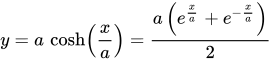
for a given value of a. A weighted catenary has the equation
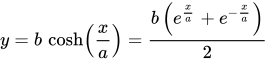
and now two constants enter: a and b.
Significance

A freestanding catenary arch has a uniform thickness. However, if
- the arch is not of uniform thickness,
- the arch supports more than its own weight,
- or if gravity varies,
it becomes more complex. A weighted catenary is needed.
The aspect ratio of a weighted catenary (or other curve) describes a rectangular frame containing the selected fragment of the curve theoretically continuing to the infinity.
Examples
The Gateway Arch in the American city of St. Louis, Missouri, is the most famous example of a weighted catenary.
Simple suspension bridges use weighted catenaries.


