factograf
EN
Sign in

maritime disaster in the North Atlantic Ocean on the night of 14–15 April 1912

Sinking of the Titanic

Sinking of the Titanic

The sinking of the Titanic was a maritime disaster in which the RMS Titanic, the largest ocean liner in service at the time, struck an iceberg in the North Atlantic Ocean on the night of 14 April 1912 and sank early the next morning. Four days into her maiden voyage from Southampton to New York City with more than 2,200 people aboard, she went down with the loss of up to 1,635 lives, making it one of the deadliest peacetime maritime disasters in history. The shortage of lifeboats and the lack of attention paid to ice warnings caused widespread outrage.

Background to the voyage

Titanic on sea trials on 2 April 1912
SS New York in her near collision with the Titanic on 10 April 1912
One of seven ice warnings received by the Titanic
An iceberg photographed on the morning of 15 April 1912 by the chief steward of SS Prinz Adalbert, with a streak of red paint along its waterline that led to speculation it could be the one Titanic struck
Drawing of the iceberg collision
Bulkhead arrangement with damaged areas shown in green
Titanic Captain Edward Smith in 1911
Captain Smith sending distress messages to Jack Phillips, depicted in a 1912 illustration by Francis Arnold Collins
Lifeboat No. 6 under capacity
9 images

When she entered service in April 1912, Titanic was the second of three Olympic-class liners and the largest ship in the world, built on an unprecedented scale with the largest reciprocating engines ever made. Her passengers ranged from wealthy millionaires travelling in luxurious first-class suites to emigrants from many countries seeking a new life in the United States. Most of her crew were not trained sailors but engineers, stokers, stewards and galley staff, and only a small share were experienced seamen.

The collision and sinking

The Sad Parting, a 1912 illustration
Distress signal sent at about 01:40 by Titanic's radio operator Jack Phillips to the Russian American Line ship SS Birma, one of Titanic's last intelligible radio messages
Lifeboat No. 15 being nearly lowered onto lifeboat No. 13, depicted in an illustration by Charles Dixon
Sinking of the Titanic, an April 1912 portrait by Henry Reuterdahl
Nearer, My God, To Thee, a 1912 illustration
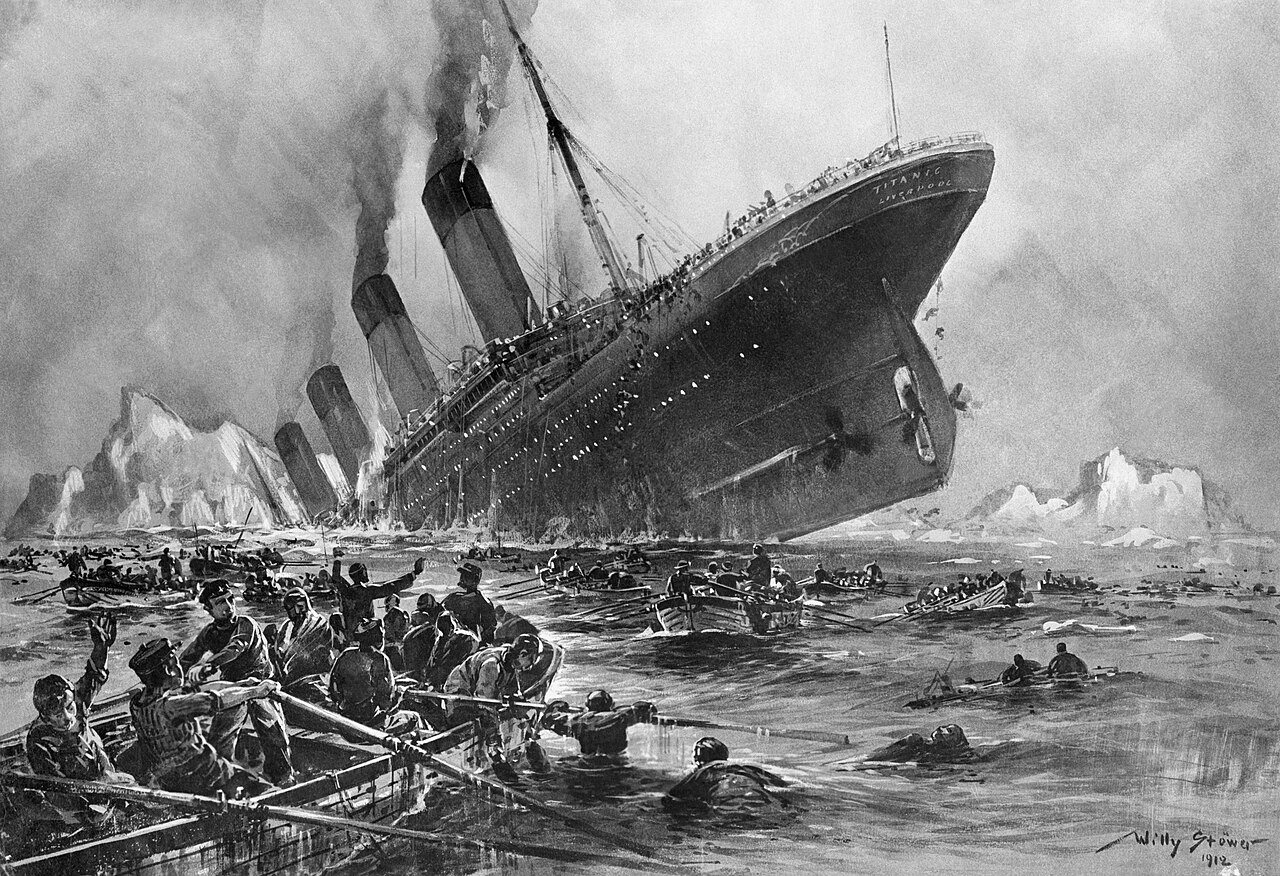
Illustration of the sinking of the Titanic
Imagined view of Titanic's final plunge
Simplified visualisation of the top-down and Mengot break-up models
8 images

Titanic received seven warnings of sea ice but was still travelling at roughly 22 knots when her lookouts sighted an iceberg. Unable to turn quickly enough, she suffered a glancing blow that opened six of her sixteen compartments to the sea, exceeding the flooding her design could withstand. The ship had only twenty lifeboats, which were not sufficient for everyone aboard, and many were launched before they were full. Around 1,500 people remained on board when she sank, and nearly all who entered the water died within minutes, while the survivors were rescued by RMS Carpathia.

Aftermath and reforms

A pocket watch retrieved from the wreck site, which stopped at 2:28
Colonel Archibald Gracie, a survivor on collapsible lifeboat B, who never recovered from his ordeal and died eight months after the sinking
Collapsible lifeboat D photographed from the deck of Carpathia on the morning of 15 April 1912
Arrival of the ship of sorrow at New York, a 1912 illustration by L.F. Grant
London paperboy Ned Parfett outside the White Star Line offices
Preparations for the arrival of deceased victims in Halifax
Time to Get Busy by Fisher, 1912; public outrage at the disaster led politicians to impose new regulations on the shipping industry
Wreck of the Titanic, 2004
8 images

The disaster caused public outrage over the shortage of lifeboats and the handling of ice warnings, as well as criticism of SS Californian, which was the closest ship but did not respond to the distress calls. Inquiries recommended sweeping changes to maritime regulations. These led to the International Convention for the Safety of Life at Sea (SOLAS) in 1914, a treaty that still governs maritime safety today.

In 12 languages

Редакція Factograf · Published October 14, 2026 · Partly based on Wikipedia, CC BY-SA 4.0 · Source article