
The Second Polish Republic, officially the Republic of Poland, was the Polish state that existed from 7 October 1918 until 6 October 1939. It emerged at the end of World War I after more than a century of partitions among Austria, Prussia and Russia. Its borders were largely settled by 1922 after regional conflicts, most importantly the Polish-Soviet war. The state was invaded in 1939 by Nazi Germany, the Soviet Union and the Slovak Republic, which marked the start of the European theatre of the Second World War. Its legacy is commonly treated as the precursor to the later Polish People's Republic and Third Polish Republic.
Background and formation


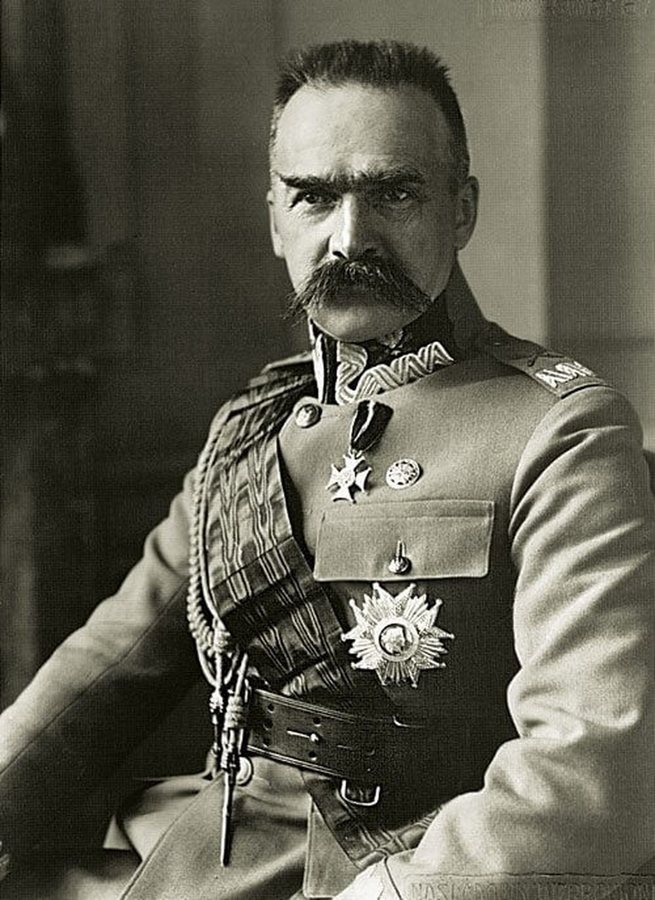


Poland regained sovereignty in 1917–1918 as the German and Austro-Hungarian empires collapsed. A German-sponsored Kingdom of Poland, established in 1917, dissolved in October 1918 and announced its intention to restore independence. Political developments followed quickly, including workers' councils, rival provisional governments and the return of Józef Piłsudski from German captivity. On 14 November 1918 the Regency Council transferred its authority to Piłsudski as Chief of State. Several states, including Italy, recognised the new republic early on.
Territory and population


The republic bordered Czechoslovakia, Germany, the Free City of Danzig, Lithuania, Latvia, Romania and the Soviet Union, and reached the Baltic Sea through the Polish Corridor. In 1938 it was the sixth largest country in Europe. Its population grew from about 25.7 million at the 1921 census to an estimated 35.1 million by 1939. Around a third of inhabitants belonged to minority groups, including Ukrainians, Ashkenazi Jews, Belarusians, Germans and Czechs. Warsaw, Kraków, Poznań, Wilno and Lwów grew into major European cities with internationally recognised universities.
Political developments


Piłsudski staged a coup in 1926 and retained major influence until his death in 1935. Afterwards, the ruling Pilsudskites increasingly discriminated against Jewish citizens, and to a lesser extent Ukrainian and Belarusian citizens, by restricting Jewish entry into professions and placing limits on Jewish businesses. These policies, along with economic development that remained moderate, shaped the state in its final years before the 1939 invasion.