factograf
EN
Sign in

Root of unity modulo n

In mathematics, a kth root of unity modulo n for positive integers k, n ≥ 2, is a root of unity in the ring of integers modulo n; that is, a solution x to the equation (or congruence) {\displaystyle x^{k}\equiv 1{\pmod {n}}}. If k is the smallest such exponent for x, then x is called a primitive kth root of unity modulo n. See modular arithmetic for notation and terminology.

The roots of unity modulo n are exactly the integers that are coprime with n. In fact, these integers are roots of unity modulo n by Euler's theorem, and the other integers cannot be roots of unity modulo n, because they are zero divisors modulo n.

A primitive root modulo n, is a generator of the group of units of the ring of integers modulo n. There exist primitive roots modulo n if and only if {\displaystyle \lambda (n)=\varphi (n),} where {\displaystyle \lambda } and {\displaystyle \varphi } are respectively the Carmichael function and Euler's totient function.
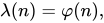
A root of unity modulo n is a primitive kth root of unity modulo n for some divisor k of {\displaystyle \lambda (n),} and, conversely, there are primitive kth roots of unity modulo n if and only if k is a divisor of {\displaystyle \lambda (n).}

Roots of unity

Properties

  • If x is a kth root of unity modulo n, then x is a unit (invertible) whose inverse is {\displaystyle x^{k-1}}. That is, x and n are coprime.
  • If x is a unit, then it is a (primitive) kth root of unity modulo n, where k is the multiplicative order of x modulo n.
  • If x is a kth root of unity and {\displaystyle x-1} is not a zero divisor, then {\displaystyle \sum _{j=0}^{k-1}x^{j}\equiv 0{\pmod {n}}}, because
{\displaystyle (x-1)\cdot \sum _{j=0}^{k-1}x^{j}\equiv x^{k}-1\equiv 0{\pmod {n}}.}

Number of kth roots

For the lack of a widely accepted symbol, we denote the number of kth roots of unity modulo n by {\displaystyle f(n,k)}. It satisfies a number of properties:

Examples

Let {\displaystyle n=7} and {\displaystyle k=3}. In this case, there are three cube roots of unity (1, 2, and 4). When {\displaystyle n=11} however, there is only one cube root of unity, the unit 1 itself. This behavior is quite different from the field of complex numbers where every nonzero number has k kth roots.

Primitive roots of unity

Properties

  • The maximum possible radix exponent for primitive roots modulo {\displaystyle n} is {\displaystyle \lambda (n)}, where λ denotes the Carmichael function.
  • A radix exponent for a primitive root of unity is a divisor of {\displaystyle \lambda (n)}.
  • Every divisor {\displaystyle k} of {\displaystyle \lambda (n)} yields a primitive {\displaystyle k}th root of unity. One can obtain such a root by choosing a {\displaystyle \lambda (n)}th primitive root of unity (that must exist by definition of λ), named {\displaystyle x} and compute the power {\displaystyle x^{\lambda (n)/k}}.
  • If x is a primitive kth root of unity and also a (not necessarily primitive) ℓth root of unity, then k is a divisor of ℓ. This is true, because Bézout's identity yields an integer linear combination of k and ℓ equal to {\displaystyle \gcd(k,\ell)}. Since k is minimal, it must be {\displaystyle k=\gcd(k,\ell)} and {\displaystyle \gcd(k,\ell)} is a divisor of ℓ.

Number of primitive kth roots

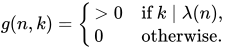
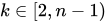
For the lack of a widely accepted symbol, we denote the number of primitive kth roots of unity modulo n by {\displaystyle g(n,k)}. It satisfies the following properties:

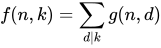
{\displaystyle f=\mathbf {1} *g}, i.e. {\displaystyle f(n,k)=\sum _{d\mid k}g(n,d)}
One can compute values of {\displaystyle g} recursively from {\displaystyle f} using this formula, which is equivalent to the Möbius inversion formula.

Testing whether x is a primitive kth root of unity modulo n

By fast exponentiation, one can check that {\displaystyle x^{k}\equiv 1{\pmod {n}}}. If this is true, x is a kth root of unity modulo n but not necessarily primitive. If it is not a primitive root, then there would be some divisor ℓ of k, with {\displaystyle x^{\ell }\equiv 1{\pmod {n}}}. In order to exclude this possibility, one has only to check for a few ℓ's equal k divided by a prime.

That is, x is a primitive kth root of unity modulo n if and only if {\textstyle x^{k}\equiv 1{\pmod {n}}} and {\displaystyle x^{k/p}\not \equiv 1{\pmod {n}}} for every prime divisor p of n.

For example, if {\displaystyle n=17,} every positive integer less than 17 is a 16th root of unity modulo 17, and the integers that are primitive 16th roots of unity modulo 17 are exactly those such that {\displaystyle x^{16/2}\not \equiv 1{\pmod {17}}.}

Finding a primitive kth root of unity modulo n

Among the primitive kth roots of unity, the primitive {\displaystyle \lambda (n)}th roots are most frequent. It is thus recommended to try some integers for being a primitive {\displaystyle \lambda (n)}th root, what will succeed quickly. For a primitive {\displaystyle \lambda (n)}th root x, the number {\displaystyle x^{\lambda (n)/k}} is a primitive {\displaystyle k}th root of unity. If k does not divide {\displaystyle \lambda (n)}, then there will be no kth roots of unity, at all.

Finding multiple primitive kth roots modulo n

Once a primitive kth root of unity x is obtained, every power {\displaystyle x^{\ell }} is a {\displaystyle k}th root of unity, but not necessarily a primitive one. The power {\displaystyle x^{\ell }} is a primitive {\displaystyle k}th root of unity if and only if {\displaystyle k} and {\displaystyle \ell } are coprime. The proof is as follows: If {\displaystyle x^{\ell }} is not primitive, then there exists a divisor {\displaystyle m} of {\displaystyle k} with {\displaystyle (x^{\ell })^{m}\equiv 1{\pmod {n}}}, and since {\displaystyle k} and {\displaystyle \ell } are coprime, there exists integers {\displaystyle a,b} such that {\displaystyle ak+b\ell =1}. This yields

{\displaystyle x^{m}\equiv (x^{m})^{ak+b\ell }\equiv (x^{k})^{ma}((x^{\ell })^{m})^{b}\equiv 1{\pmod {n}}},

which means that {\displaystyle x} is not a primitive {\displaystyle k}th root of unity because there is the smaller exponent {\displaystyle m}.

That is, by exponentiating x one can obtain {\displaystyle \varphi (k)} different primitive kth roots of unity, but these may not be all such roots. However, finding all of them is not so easy.

Finding an n with a primitive kth root of unity modulo n

A motivating question is, in what integer residue class rings does a primitive kth root of unity exist? It can be used to compute a discrete Fourier transform (more precisely a number theoretic transform) of a {\displaystyle k}-dimensional integer vector. In order to perform the inverse transform, divide by {\displaystyle k}; that is, k is also a unit modulo {\displaystyle n.}

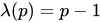
A simple way to find such an n is to check for primitive kth roots with respect to the moduli in the arithmetic progression {\displaystyle k+1,2k+1,3k+1,\dots } All of these moduli are coprime to k and thus k is a unit. According to Dirichlet's theorem on arithmetic progressions there are infinitely many primes in the progression, and for a prime {\displaystyle p}, it holds {\displaystyle \lambda (p)=p-1}. Thus if {\displaystyle mk+1} is prime, then {\displaystyle \lambda (mk+1)=mk}, and thus there are primitive kth roots of unity. But the test for primes is too strong, and there may be other appropriate moduli.

Finding an n with multiple primitive roots of unity modulo n

To find a modulus {\displaystyle n} such that there are primitive {\displaystyle k_{1}{\text{th}},k_{2}{\text{th}},\ldots,k_{m}{\text{th}}} roots of unity modulo {\displaystyle n}, the following theorem reduces the problem to a simpler one:

For given {\displaystyle n} there are primitive {\displaystyle k_{1}{\text{th}},\ldots,k_{m}{\text{th}}} roots of unity modulo {\displaystyle n} if and only if there is a primitive {\displaystyle \operatorname {lcm} (k_{1},\ldots,k_{m})}th root of unity modulo n.
Proof

Backward direction: If there is a primitive {\displaystyle \operatorname {lcm} (k_{1},\ldots,k_{m})}th root of unity modulo {\displaystyle n} called {\displaystyle x}, then {\displaystyle x^{\operatorname {lcm} (k_{1},\ldots,k_{m})/k_{l}}} is a {\displaystyle k_{l}}th root of unity modulo {\displaystyle n}.
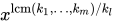
Forward direction: If there are primitive {\displaystyle k_{1}{\text{th}},\ldots,k_{m}{\text{th}}} roots of unity modulo {\displaystyle n}, then all exponents {\displaystyle k_{1},\dots,k_{m}} are divisors of {\displaystyle \lambda (n)}. This implies {\displaystyle \operatorname {lcm} (k_{1},\dots,k_{m})\mid \lambda (n)} and this in turn means there is a primitive {\displaystyle \operatorname {lcm} (k_{1},\ldots,k_{m})}th root of unity modulo {\displaystyle n}.

Read next

In 3 languages

Text from Wikipedia, CC BY-SA 4.0 · Source article