Romani people, also called Roma, are an Indo-Aryan ethnic group who traditionally led a nomadic, itinerant lifestyle. Linguistic and genetic evidence suggests they originated in northwestern parts of the Indian subcontinent, and historians believe their westward migration occurred around 1000 CE. Today they are dispersed, but their largest populations live in central, eastern, and southern Europe, as well as in western Asia, mainly Turkey and Iran.
Migration and origins
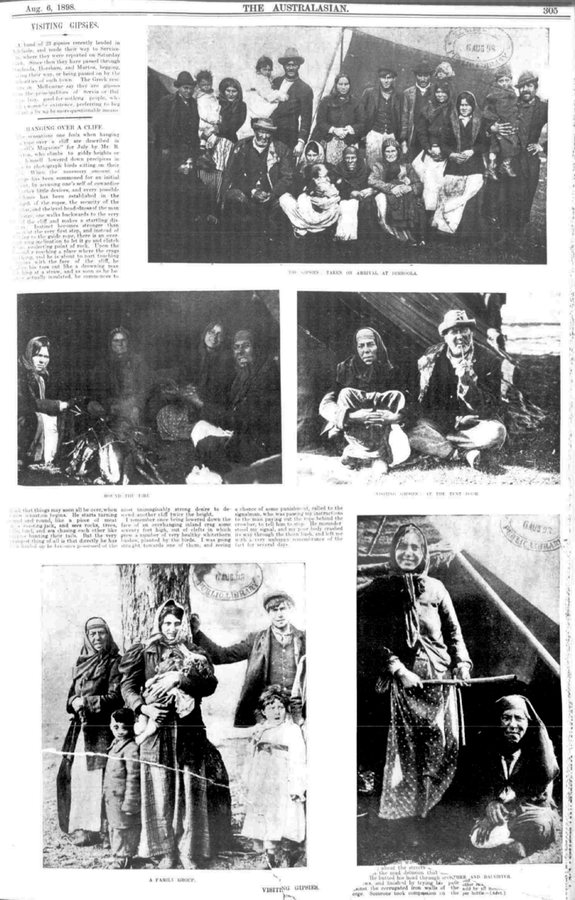
Two Gypsies by Francisco IturrinoKalo Romani women in Helsinki, Finland, 1930sJean-Baptiste Debret: Interior of a gipsy's house in Brazil (c. 1820)Gypsies camping. Kalé Roma near Swansea in Wales, 1953Ursari Roma in Šmarca, Slovenia, 1934A Romanichal vardo pictured at the Great Dorset Steam Fair in 2007, England"Visiting Gipsies", article from Australian newspaper, The Australasian, 1898A Rom makes a complaint to a local magistrate in Hungary, by Sándor Bihari, 1886The most common paternal haplogroup among Roma is the South Asian Y-chromosome H, most commonly found among Dravidian peoples.The migration of the Romanies into and through EuropeFirst arrival of the Romanies outside Bern in the 15th century, described by the chronicler as "baptized heathens" wearing Saracen-style clothing and weapons.Gypsy Family in Prison, 1864 painting by Carl d'Unker, with imprisoned family in Germany as models; reason for imprisonment unknown
12 images
Their original name may derive from the Sanskrit word doma, which may refer to the Doma, a Dalit caste traditionally associated with musicians and dancers. The Romani moved west into the Ghaznavid and later Byzantine empires, reaching Europe around the 13th to 14th century via the Balkans. Since the 19th century, some have migrated to the Americas, with notable communities in the United States and Brazil.
Language and names
Romani women in Lincoln Heights Jail, Los Angeles, California, 1940Deportation of Roma from Asperg, Germany, 1940 (photograph by the Rassenhygienische Forschungsstelle)Distribution of the Roma in Europe (2007 Council of Europe average estimates, totalling 9.8 million)Anti-Romani protests in Sofia, Bulgaria, 2011Roma people in Gjakova, Kosovo, 2005Muchacha GitanaThe Visit of the Gypsies 01Vouet, Simon: The Fortune TellerDavid Teniers II: Four gypsies with a child, one telling a peasant his fortuneJan van der Venne: Gypsy familySarah Egerton as Meg MerriliesPongrácz F: Három cigány
12 images
The Romani language is an Indo-Aryan language with strong Persian, Armenian, Greek, and South Slavic influence, and Balkan varieties also show extensive Turkish influence. It has several dialects with more than 2 million speakers. In English the group is widely known as Gypsies, a term many Romani consider pejorative, and the first World Romani Congress in 1971 voted to reject all exonyms.