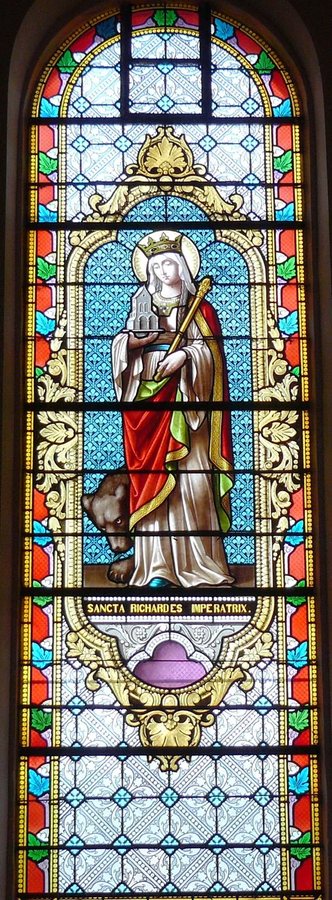
Richardis was a 9th-century Carolingian empress and the wife of Charles the Fat. Born in Alsace around 840, she was crowned in Rome in 881. Following a childless marriage and subsequent accusations of adultery by her husband, she was eventually repudiated. She later became the first abbess of the monastery she founded at Andlau. Recognized for her religious devotion, she is remembered as a saint in the Catholic, Anglican, and Orthodox traditions.
Life and reign

As the daughter of Count Erchanger, Richardis married Charles in 862. During her husband's reign, the empire faced significant instability from Norman raids. When Charles suffered from mental illness, Richardis attempted to govern, but she was ultimately accused of infidelity by the court. After a papal commission confirmed her innocence, she withdrew to the abbey at Andlau, where she lived as an abbess until her death in the mid-1300s.
Legends and miracles

Tradition holds that Richardis survived an ordeal by fire to prove her purity. Another legend suggests she encountered a grieving mother bear in the forest, after which she founded a convent. Because of these stories, she is often depicted alongside a bear in religious art. The nuns at Andlau historically maintained a connection to this imagery by hosting bear-keepers at the abbey.
Veneration

She was canonized in 1049, and her remains were moved to a new tomb in the rebuilt abbey church. Today, she is venerated as the patron of Andlau and is invoked for protection against fires. Her iconography frequently combines symbols of her imperial status with those of her monastic life and her survival of the fire ordeal.