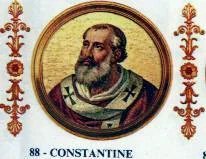
Constantine was a Greek-descended pope who served as the bishop of Rome from 708 until his death in 715. Born in Tyre, he was deeply familiar with Eastern traditions and the Byzantine court, having previously served as a papal legate. His leadership occurred during the Byzantine Papacy, a period when the Roman pontiffs required imperial approval. He is most notable for traveling to Constantinople to negotiate with Emperor Justinian II, seeking to prevent a significant rift between the Eastern and Western churches regarding the Trullan canons.
Life and leadership

Following the brief reign of Sisinnius, Constantine assumed the papacy in March 708. He was a key figure in maintaining political unity between Rome and the Byzantine Empire. During his rule, he resisted the theological demands of Emperor Philippicus, specifically rejecting the revival of monothelitism. He also refused to honor the emperor through imperial portraits or liturgical commemorations, maintaining the independence of his office against imperial pressure.
Diplomatic mission

In 710, Constantine traveled to Constantinople to meet with Justinian II. This visit aimed to address the dispute over the Trullan decrees of the Quinisext Council. Through diplomatic compromise, he managed to secure political stability between the two regions without fully abandoning Roman grievances. This mission marked the final papal visit to the imperial capital for many centuries, as no other pope returned to the city until 1967.