factograf
EN
Sign in

legendary Greek king of Ithaca and hero of Homer's Odyssey

Odysseus

Odysseus

Odysseus is a legendary Greek king of Ithaca and the hero of Homer's epic poem, the Odyssey. Known in Latin as Ulysses, he also plays a key role in Homer's Iliad and other works of the same epic cycle. He is renowned for his intellectual brilliance, guile and versatility, earning him the epithet Odysseus the Cunning. He is most famous for his nostos, or homecoming, which took him ten eventful years after the decade-long Trojan War.

Name and epithets

Head of Odysseus, Sperlonga Archaeological Museum
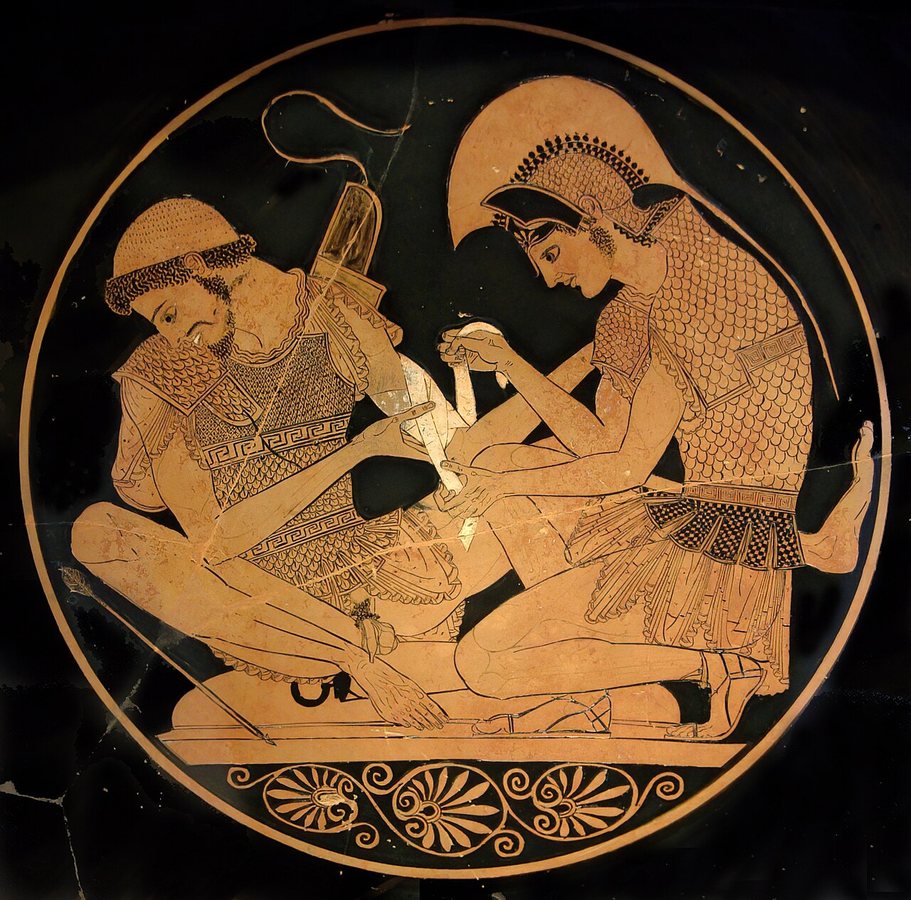
Achilles and Patroclus, Antikensammlung Berlin, F2278
Menelaus and Meriones lift Patroclus's corpse onto a cart while Odysseus looks on, Etruscan alabaster urn from Volterra, 2nd century BC
Odysseus and Diomedes steal the horses of the Thracian king Rhesus after killing him, Apulian red-figure situla from Ruvo
Roman mosaic showing Odysseus on Skyros unveiling the disguised Achilles, from La Olmeda, Spain, 5th century AD
5 images

The name Odysseus appears in various forms in ancient Greek and Latin sources, and its etymology remains unknown. Homer links it to a verb meaning to be angry or hate. Homer describes him with the epithet polytropos, meaning the man of many turns, which translators render in different ways. In Etruria the name and stories of the hero were adopted under a number of variant spellings.

Appearance and family

Oinochoe, c. 520 BC, showing Odysseus and Ajax fighting over the armour of Achilles
Odysseus in a pileus hat carries off the Palladium from Troy with Diomedes, as Cassandra and other Trojans resist, Pompeian fresco
Odysseus and his men fight the Cicones, allies of the Trojans, during the sacking of their city
Odysseus and Polyphemus (1896) by Arnold Böcklin, showing Odysseus and his crew escaping the Cyclops
4 images

Ancient authors describe Odysseus as tough, crafty, cheerful and eloquent, of medium height. According to Homer he is the son of Laertes and Anticlea and the husband of Penelope, the father of Telemachus. A non-Homeric tradition instead named Sisyphus as his true father. Odysseus is also described as having a younger sister, Ctimene.

Role in myth

Odysseus and the Sirens, Ulixes mosaic at the Bardo National Museum, Tunis, 2nd century AD
Head of Odysseus in a pileus on a 3rd-century BC coin from Ithaca
Palaiokastritsa bay in Corfu, seen from Bella Vista of Lakones, believed to be where Odysseus landed and first met Nausicaa; the rock offshore is said to be his petrified ship
Bekim Fehmiu as Odysseus in the Italian television series Odissea
4 images

Odysseus is best known for his role in the Trojan War and his long voyage home afterwards. Earlier myths about his pre-war exploits survive mainly in sources written centuries after Homer. Among them, he tries to avoid joining the war by feigning lunacy, an attempt that fails and draws him into the conflict.

In 91 languages

Редакція Factograf · Published October 14, 2026 · Partly based on Wikipedia, CC BY-SA 4.0 · Source article