factograf
EN
Sign in

Modal matrix

In linear algebra, the modal matrix is used in the diagonalization process involving eigenvalues and eigenvectors.

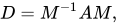
Specifically the modal matrix {\displaystyle M} for the matrix {\displaystyle A} is the n × n matrix formed with the eigenvectors of {\displaystyle A} as columns in {\displaystyle M}. It is utilized in the similarity transformation

{\displaystyle D=M^{-1}AM,}

where {\displaystyle D} is an n × n diagonal matrix with the eigenvalues of {\displaystyle A} on the main diagonal of {\displaystyle D} and zeros elsewhere. The matrix {\displaystyle D} is called the spectral matrix for {\displaystyle A}. The eigenvalues must appear left to right, top to bottom in the same order as their corresponding eigenvectors are arranged left to right in {\displaystyle M}.

Example

The matrix

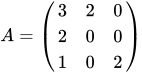
{\displaystyle A={\begin{pmatrix}3&2&0\\2&0&0\\1&0&2\end{pmatrix}}}

has eigenvalues and corresponding eigenvectors

{\displaystyle \lambda _{1}=-1,\quad \,\mathbf {b} _{1}=\left(-3,6,1\right),}
{\displaystyle \lambda _{2}=2,\qquad \mathbf {b} _{2}=\left(0,0,1\right),}
{\displaystyle \lambda _{3}=4,\qquad \mathbf {b} _{3}=\left(2,1,1\right).}

A diagonal matrix {\displaystyle D}, similar to {\displaystyle A} is

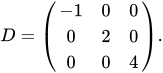
{\displaystyle D={\begin{pmatrix}-1&0&0\\0&2&0\\0&0&4\end{pmatrix}}.}

One possible choice for an invertible matrix {\displaystyle M} such that {\displaystyle D=M^{-1}AM,} is
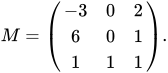
{\displaystyle M={\begin{pmatrix}-3&0&2\\6&0&1\\1&1&1\end{pmatrix}}.}

Note that since eigenvectors themselves are not unique, and since the columns of both {\displaystyle M} and {\displaystyle D} may be interchanged, it follows that both {\displaystyle M} and {\displaystyle D} are not unique.

Generalized modal matrix

Let {\displaystyle A} be an n × n matrix. A generalized modal matrix {\displaystyle M} for {\displaystyle A} is an n × n matrix whose columns, considered as vectors, form a canonical basis for {\displaystyle A} and appear in {\displaystyle M} according to the following rules:

  • All Jordan chains consisting of one vector (that is, one vector in length) appear in the first columns of {\displaystyle M}.
  • All vectors of one chain appear together in adjacent columns of {\displaystyle M}.
  • Each chain appears in {\displaystyle M} in order of increasing rank (that is, the generalized eigenvector of rank 1 appears before the generalized eigenvector of rank 2 of the same chain, which appears before the generalized eigenvector of rank 3 of the same chain, etc.).

One can show that

1

where {\displaystyle J} is a matrix in Jordan normal form. By premultiplying by {\displaystyle M^{-1}}, we obtain

2

Note that when computing these matrices, equation (1) is the easiest of the two equations to verify, since it does not require inverting a matrix.

Example

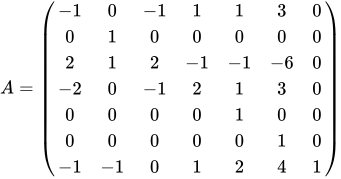
This example illustrates a generalized modal matrix with four Jordan chains. Unfortunately, it is a little difficult to construct an interesting example of low order. The matrix
{\displaystyle A={\begin{pmatrix}-1&0&-1&1&1&3&0\\0&1&0&0&0&0&0\\2&1&2&-1&-1&-6&0\\-2&0&-1&2&1&3&0\\0&0&0&0&1&0&0\\0&0&0&0&0&1&0\\-1&-1&0&1&2&4&1\end{pmatrix}}}

has a single eigenvalue {\displaystyle \lambda _{1}=1} with algebraic multiplicity {\displaystyle \mu _{1}=7}. A canonical basis for {\displaystyle A} will consist of one linearly independent generalized eigenvector of rank 3 (generalized eigenvector rank; see generalized eigenvector), two of rank 2 and four of rank 1; or equivalently, one chain of three vectors {\displaystyle \left\{\mathbf {x} _{3},\mathbf {x} _{2},\mathbf {x} _{1}\right\}}, one chain of two vectors {\displaystyle \left\{\mathbf {y} _{2},\mathbf {y} _{1}\right\}}, and two chains of one vector {\displaystyle \left\{\mathbf {z} _{1}\right\}}, {\displaystyle \left\{\mathbf {w} _{1}\right\}}.

An "almost diagonal" matrix {\displaystyle J} in Jordan normal form, similar to {\displaystyle A} is obtained as follows:

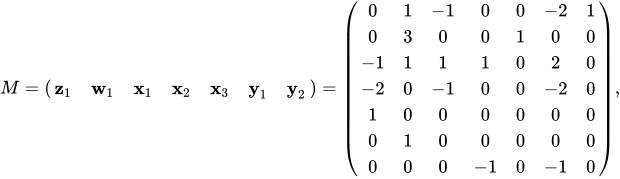
{\displaystyle M={\begin{pmatrix}\mathbf {z} _{1}&\mathbf {w} _{1}&\mathbf {x} _{1}&\mathbf {x} _{2}&\mathbf {x} _{3}&\mathbf {y} _{1}&\mathbf {y} _{2}\end{pmatrix}}={\begin{pmatrix}0&1&-1&0&0&-2&1\\0&3&0&0&1&0&0\\-1&1&1&1&0&2&0\\-2&0&-1&0&0&-2&0\\1&0&0&0&0&0&0\\0&1&0&0&0&0&0\\0&0&0&-1&0&-1&0\end{pmatrix}},}
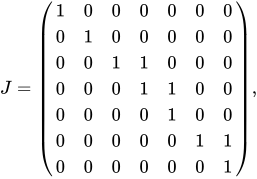
{\displaystyle J={\begin{pmatrix}1&0&0&0&0&0&0\\0&1&0&0&0&0&0\\0&0&1&1&0&0&0\\0&0&0&1&1&0&0\\0&0&0&0&1&0&0\\0&0&0&0&0&1&1\\0&0&0&0&0&0&1\end{pmatrix}},}

where {\displaystyle M} is a generalized modal matrix for {\displaystyle A}, the columns of {\displaystyle M} are a canonical basis for {\displaystyle A}, and {\displaystyle AM=MJ}. Note that since generalized eigenvectors themselves are not unique, and since some of the columns of both {\displaystyle M} and {\displaystyle J} may be interchanged, it follows that both {\displaystyle M} and {\displaystyle J} are not unique.

Read next

In 3 languages

Text from Wikipedia, CC BY-SA 4.0 · Source article