factograf
EN
Sign in

Russian Romantic writer, poet and painter (1814–1841)

Mikhail Lermontov

Mikhail Lermontov

Mikhail Lermontov was a Russian Romantic writer, poet and painter who lived from 1814 to 1841. Often called the poet of the Caucasus, he became the most important Russian poet after Alexander Pushkin's death in 1837. His poetry and prose, including the novel A Hero of Our Time, shaped the Russian psychological novel. He was killed in a duel with a fellow officer in 1841, at the age of 26.

Family and childhood

Maria Mikhaylovna Lermontova (1795–1817), mother
Yuri Petrovich Lermontov (1787–1831), father
Elizaveta Arsenyeva, grandmother
Lermontov as a child
Lermontov's handwritten request to Moscow University to leave
Lermontov in 1834, portrait by Pyotr Zakharov-Chechenets
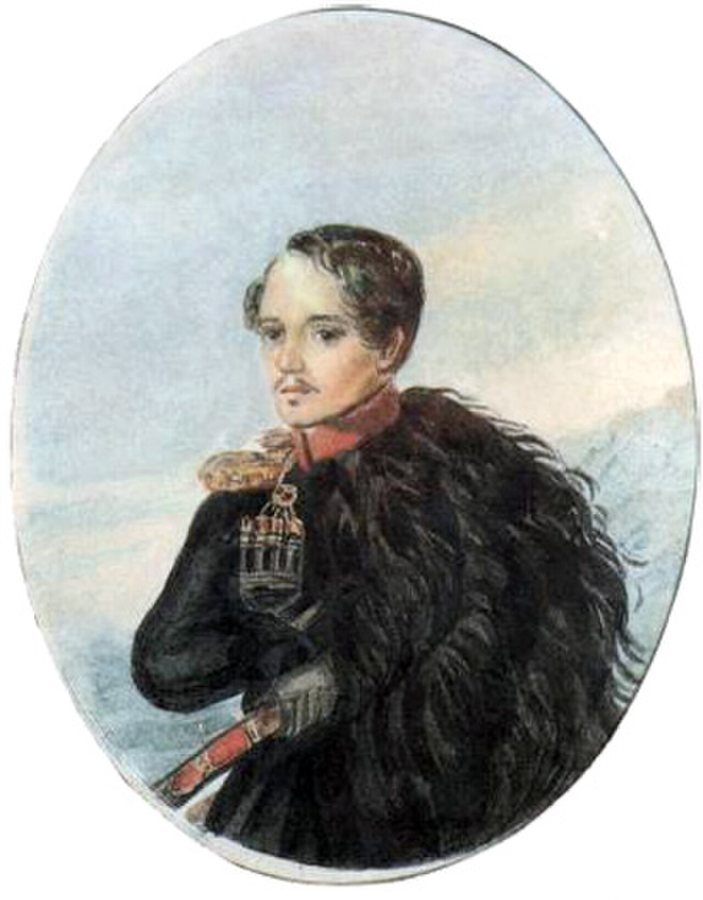
Self-portrait, 1837
Self-portrait, 1837
An 1837 landscape by Lermontov, Tiflis, 1837
Lermontov took delight in painting mountain landscapes
The little house in Pyatigorsk where Lermontov spent the last two months of his life
Lermontov after the first exile, 1838
11 images

Lermontov was born in Moscow, but grew up mainly in the village of Tarkhany with his grandmother, Elizaveta Arsenyeva. His parents' marriage was unhappy, and his mother died when he was a small child. His father lived apart from him, and the grandmother kept the boy for years. She gave him an extensive home education in languages, music and painting. His fragile health led to frequent trips to the Caucasus, which deeply affected him.

Literary career and exile

Countess Emilie Musin-Pushkina (1811–1846), who confessed to a friend that she had fallen in love with Lermontov; as a married woman she never committed adultery
Lermontov after the Valerik battle, D. F. Palen's drawing, 1840
The last portrait of Lermontov, by Kirill Gorbunov, 1841
The 1887 engraving from the 1841 coffin portrait
Portrait of Varvara Bakhmeteva, 1833, by Edmond Pierre Martin
Natalya Ivanova in the 1840s
Lermontov's tombstone in Tarkhany
Georgian Military Road, Lermontov's painting, 1837
Mikhail Vrubel's illustration to Demon (1890)
Pyatigorsk, Lermontov's duel location (photo from 1958)
The site of the 1841 duel
11 images

In 1832 Lermontov moved to Saint Petersburg and joined the army. His sharp satirical writing made him enemies, while his poem on Pushkin's death brought him fame and his first exile to the Caucasus. There he wrote some of his best-known works. After a brief return to the capital and another duel, he was exiled again. His death in a duel in 1841 ended a career that many regarded as among the most promising in Russian literature.

In 85 languages

Редакція Factograf · Published October 14, 2026 · Partly based on Wikipedia, CC BY-SA 4.0 · Source article