factograf
EN
Sign in

president of Venezuela (1999–2013); revolutionary and military officer

Hugo Chávez

Hugo Chávez

Hugo Chávez (1954–2013) was a Venezuelan politician, revolutionary and military officer who served as president of Venezuela from 1999 until his death in 2013. He led the Bolivarian Revolution, renamed the country the Bolivarian Republic of Venezuela, and founded the political movement that later became the ruling United Socialist Party of Venezuela. The ideology built around his ideas is known as Chavismo. He is regarded as one of the most influential and controversial figures in modern Venezuelan and Latin American history.

Early life and military career

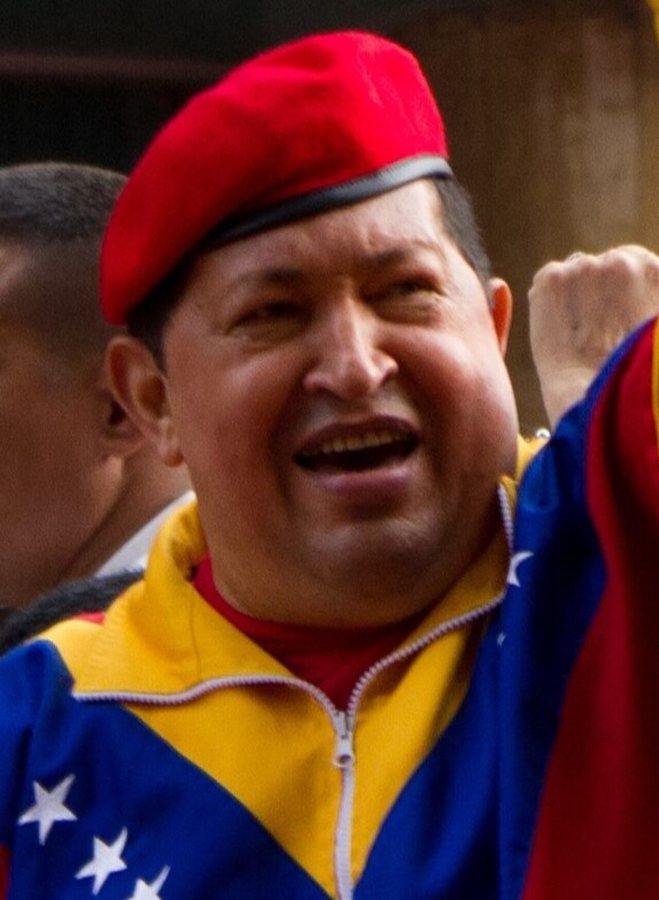
Hugo Chávez, portrait
Hugo Chávez, 2012
Hugo Chávez, 2012
Chávez as an adolescent
Chávez as a student at the military academy
Chávez while serving in the Venezuelan Army
The San Carlos military stockade, where Chávez was held after the 1992 coup attempt
Chávez speaking at an event in Buenos Aires in October 1995
A 1997 image of MBR-200 members meeting, with Nicolás Maduro on the far left and Chávez speaking in the centre
A painted mural supporting the Fifth Republic Movement (MVR) in Barcelona, Anzoátegui, Venezuela
Chávez's second term saw the launch of social missions, such as this one to eliminate illiteracy in Venezuela
Chávez visiting the USS Yorktown, a U.S. Navy ship docked at Curaçao in the Netherlands Antilles, in 2002
A 2004 rally in Caracas demanding Chávez's removal from the presidency
12 images

Chávez was born in Sabaneta, Barinas State, into a family of teachers and modest means, although later accounts of his childhood poverty have been disputed. He trained at the Venezuelan Academy of Military Sciences in Caracas, where a curriculum encouraging civilian lectures and broader study exposed him to many subjects. He became interested in the revolutionary Che Guevara and, as an officer, grew dissatisfied with the political system established by the Puntofijo Pact, which later shaped his political founding.

Presidency and reforms

Chávez in Brazil, 2008
Hundreds of thousands of Venezuelans demonstrate against Chávez's proposed constitutional referendum during the 2007 protests
Chávez (far right) with fellow Latin American leftist presidents in 2009: Fernando Lugo of Paraguay, Evo Morales of Bolivia, Lula da Silva of Brazil and Rafael Correa of Ecuador
Chávez in June 2012
Chávez in June 2012
Populism series
Populism series
Simón Bolívar, the 19th-century general and politician, provided a basis for Chávez's political ideas
Historical crude oil prices, including the Chávez administration (1998–2013)
Annual GDP trends in billions of local currency units, adjusted for inflation, during the Chávez years. Sources: International Monetary Fund, World Bank
Shoppers queue at a government-run MERCAL store
The implied value of the hard bolívar (VEF) against the US dollar compared with the official government rate. Sources: Banco Central de Venezuela, Dolar Paralelo, Federal Reserve Bank, International Monetary Fund
Murder rate per 100,000 citizens from 1998 to 2018. Sources: OVV, PROVEA, UN; the UN line between 2007 and 2012 is simulated due to missing data
Number of kidnappings in Venezuela, 1989–2011. Source: CICPC; express kidnappings may not be included
12 images

After founding a political party and being pardoned following a failed 1992 coup attempt, Chávez won the presidency in 1998 and was reelected in 2000 and 2006. Following the 1999 Constitution, his government pursued social reforms financed by high oil revenues, including nationalizations and social programs called the Bolivarian missions. These initiatives brought temporary gains in poverty reduction, but as oil prices fell, the economy weakened, and critics also cited democratic backsliding and rising crime during his rule.

Legacy

Venezuela's perception of corruption scores between 2004 and 2013, averaged by Transparency International's method. Source: Transparency International
Raúl Reyes
Raúl Reyes
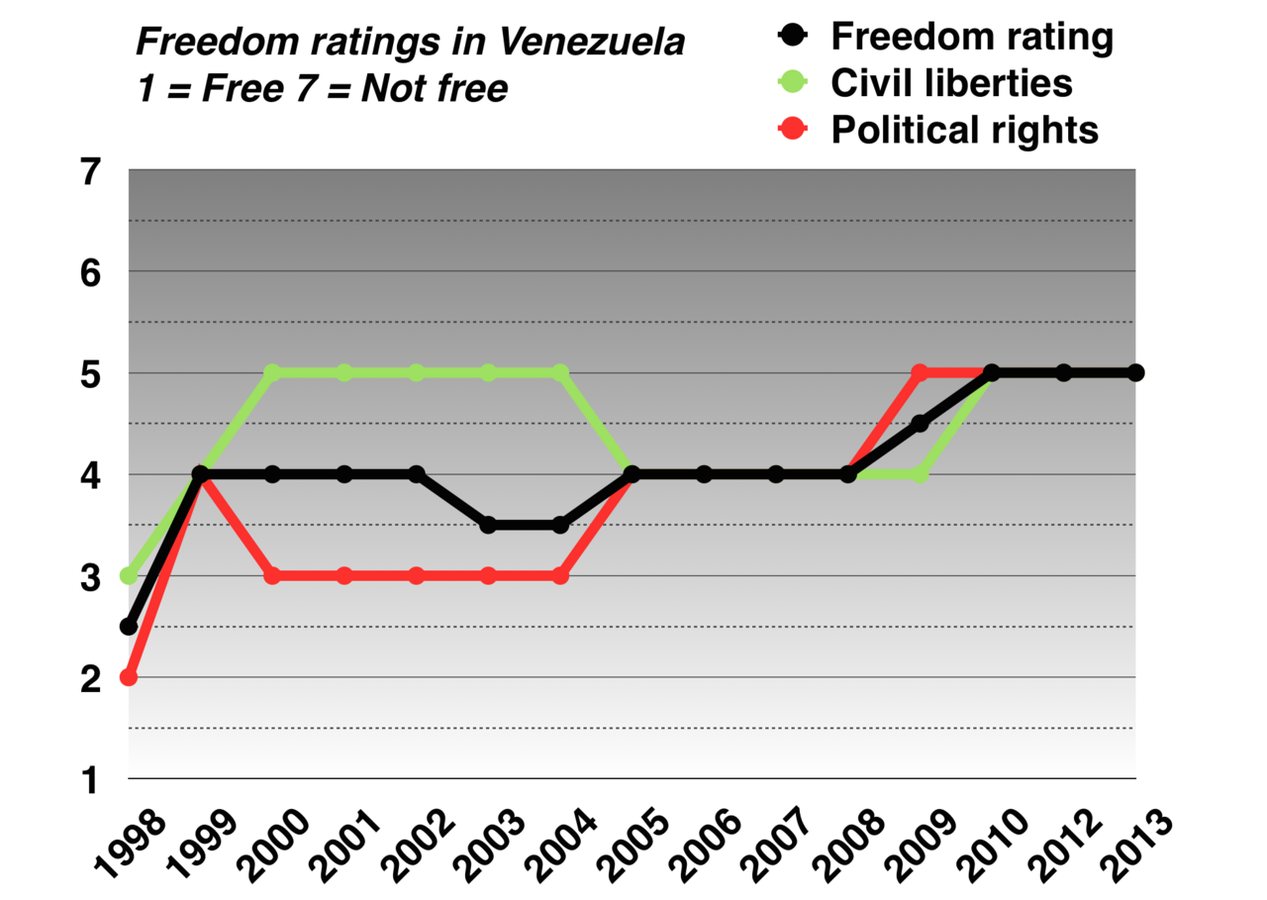
Freedom ratings in Venezuela from 1998 to 2013, where 1 is free and 7 is not free. Source: Freedom House
Chávez meets US Secretary of State Clinton at the Summit of the Americas on 19 April 2009
Venezuelans protest the closure of RCTV
Chávez with Brazilian President Dilma Rousseff in Brasília, 6 June 2011
Chávez walks with a cane, accompanied by Ecuadorian president Rafael Correa in Caracas in July 2011, shortly after his first cancer surgery
Mausoleum where Hugo Chávez's remains rest in Caracas
The public pays respects at Chávez's funeral, 8 March 2013
Mausoleum of Hugo Chávez in Caracas
A bust of Chávez
A bust of Chávez
A mural of Hugo Chávez in the city of Mérida
12 images

Chávez aligned Venezuela with several leftist Latin American governments and helped establish regional organizations such as the Union of South American Nations and the regional broadcaster TeleSUR. He described his policies as anti-imperialist and opposed United States foreign policy. He died in Caracas in March 2013 while receiving cancer treatment, and his presidency is widely studied as the start of the so-called pink tide in Latin America.

In 138 languages

Редакція Factograf · Published October 14, 2026 · Partly based on Wikipedia, CC BY-SA 4.0 · Source article