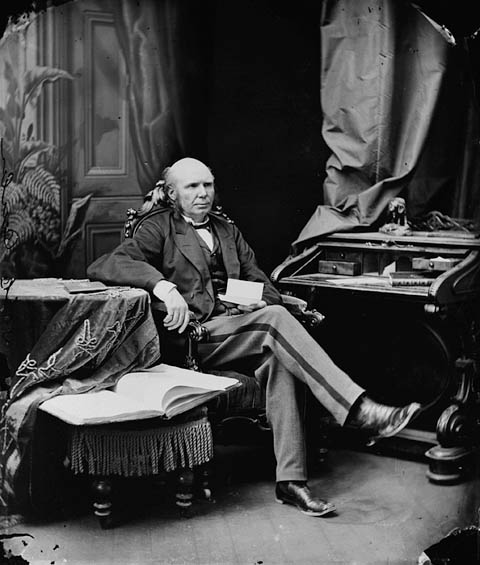
Sir Frederick Bowker Terrington Carter KCMG (February 12, 1819 – March 1, 1900) was a Newfoundlander lawyer and politician who served as Premier of Newfoundland from 1865 to 1870 and from 1874 to 1878.
Career
Carter was born on February 12, 1819 in St. John's, Newfoundland to Peter Weston Carter, a merchant, and Sydney Carter (née Livingstone). He was the grandson of William Carter and great-grandson of Robert Carter, who was appointed justice of the peace at Ferryland in 1750. In 1855, he was elected to the House of Assembly as a Conservative and was Speaker from 1861 to 1865. In 1865, he succeeded Sir Hugh Hoyles as Premier.
Carter was a supporter of Canadian Confederation having been a delegate to the 1864 Quebec conference. However, the Conservatives were defeated on the Confederation issue in the November 1869 election by the Anti-Confederation Party led by Charles Fox Bennett. Even though Newfoundland did not join the confederation until 1949, Carter is considered one of the Fathers of Confederation. Carter became Premier a second time in 1874, serving until 1878, but had dropped the issue of joining Canada. He was appointed a Knight Commander of the Order of St Michael and St George (KCMG) in 1878.
In 1880, Carter was appointed Chief Justice of the Supreme Court of Newfoundland, succeeding Sir Hugh Hoyles, and served in the post until 1898. During his term as Chief Justice, Carter was a valued advisor for the Colonial Governors of Newfoundland and acted as administrator of the colony in their absence.
Carter was a Freemason of St. John's Lodge, No. 579, a Newfoundland lodge under the United Grand Lodge of England.
He died in, St. John's, Newfoundland, on March 1, 1900, aged 81. His son Stanley went on to become a lawyer.