factograf
EN
Sign in

1941–1945 World War II theater

Eastern Front (World War II)

Eastern Front (World War II)

The Eastern Front was a theatre of World War II fought between the European Axis powers and the Allies, including the Soviet Union and Poland. It covered Central, Eastern, Northeast and Southeast Europe and lasted from 22 June 1941 to 9 May 1945. Roughly 30 million of the estimated 70 to 85 million war deaths occurred there. Historians consider it decisive for the outcome of the war in Europe, as it led to the defeat of Nazi Germany and its Axis partners.

Background and invasion

EasternFrontWWIIcolage
Semyon Timoshenko and Georgy Zhukov in 1940
Situation in Europe by May and June 1941, just before Operation Barbarossa
German soldiers in a Panzer III tank on the Kalmyk steppe north of Stalingrad, September 1942
German infantry in Russia, June 1943
The South Western Front (Ukrainian) on 22 June 1941
Muscovites gather by a loudspeaker to hear Vyacheslav Molotov announce the German invasion, 22 June 1941
Soviet children during a German air raid in the first days of the war, June 1941, from the RIA Novosti archive
The Soviet winter counter-offensive, 5 December 1941 to 7 May 1942: Soviet gains and German gains
Operation Blue: German advances from 7 May 1942 to 18 November 1942
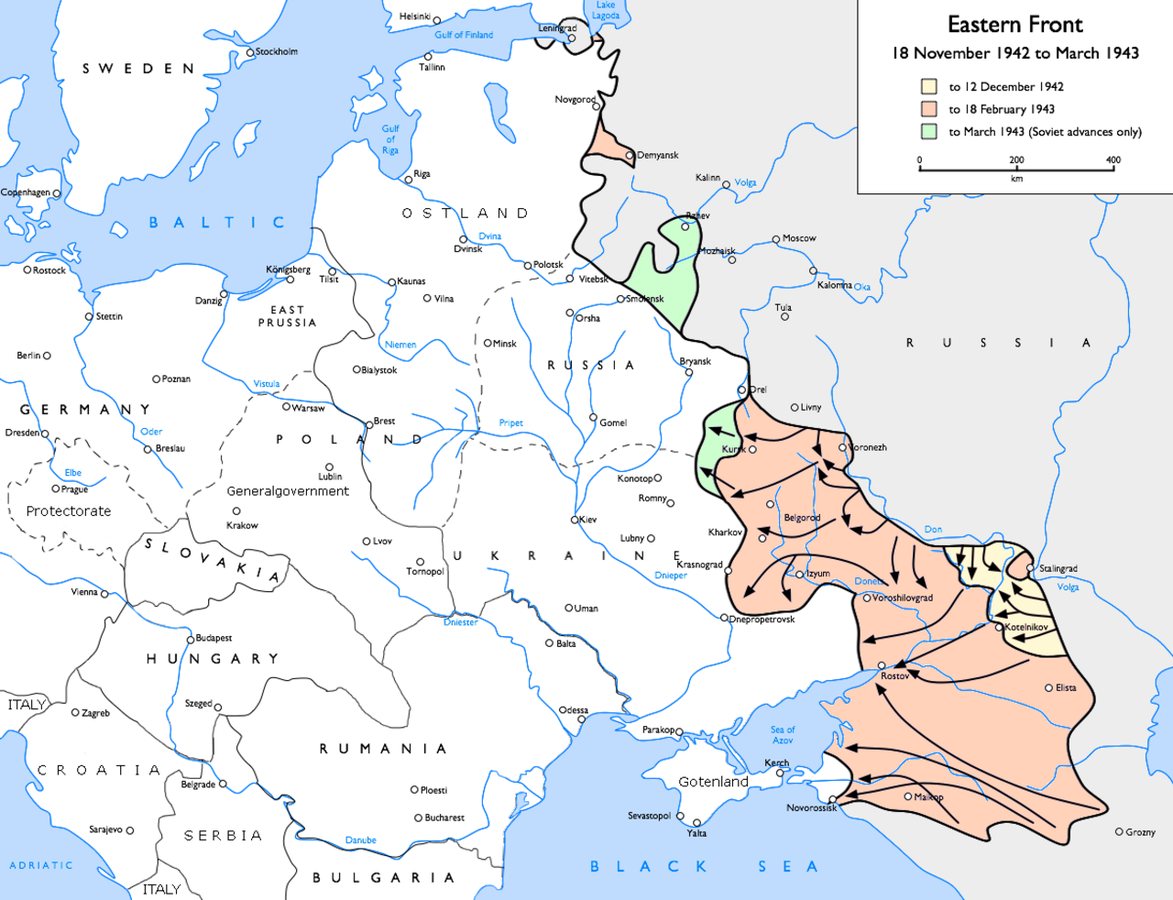
Soviet advances on the Eastern Front, 18 November 1942 to March 1943
German advances at Kharkov and Kursk, 19 February 1943 to 1 August 1943
12 images

Tensions between Germany and the Soviet Union had roots in the aftermath of the First World War, when Bolshevik Russia left the Allied camp and lost territory in Eastern Europe. The Molotov–Ribbentrop Pact of August 1939 divided Central Europe between the two states, and Germany invaded Poland that September. Adolf Hitler later launched Operation Barbarossa on 22 June 1941, and the Soviets, who had refused to prepare defences despite warnings, were largely unprepared for the attack.

Turning points and significance

Soviet advances from 1 January 1945 to 11 May 1945
14,933,000 Soviet and Soviet-allied personnel were awarded the Medal for Victory over Germany.
Soviet soldiers celebrating the German surrender in Berlin, 2 May 1945
Citizens of Leningrad during the 872-day siege, in which about one million civilians died
Adolf Hitler led Germany during World War II.
Joseph Stalin led the Soviet Union during World War II.
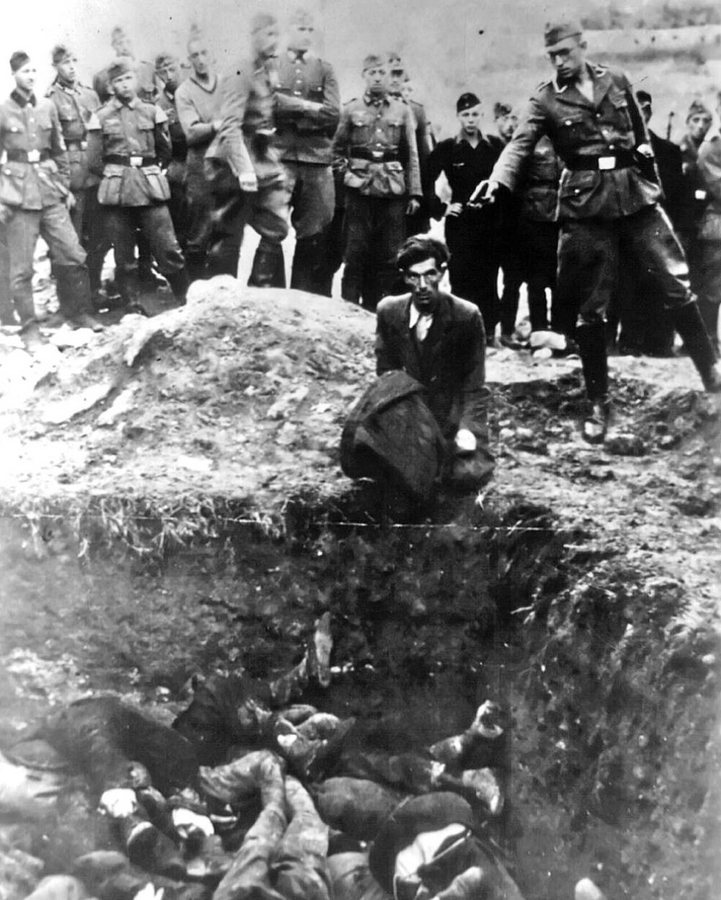
The Last Jew in Vinnitsa: a member of Einsatzgruppe D murders a Jew kneeling before a filled mass grave in Vinnitsa, 1942.
Einsatzgruppen murdering Jews in Ivanhorod, Ukraine, 1942
Viktor Cherevihkin, a Soviet teenager killed by German troops occupying Rostov for keeping pigeons
Soviet partisan Zoya Kosmodemyanskaya, hanged by German forces in November 1941
Soviet partisans hanged by German forces in January 1943
German officers of the 16th Army executing Soviet civilians, 1943
12 images

German forces came close to Moscow but failed to capture it, and the Axis advance into the Caucasus later ended in defeat at Stalingrad, one of the bloodiest battles in history. A major German defeat at Kursk weakened its offensive capacity, and Soviet operations continued until Berlin was captured. Germany signed its surrender on 8 May 1945. The theatre also saw extensive atrocities, including mass killings and deportations carried out under German occupation.

In 84 languages

Редакція Factograf · Published October 14, 2026 · Partly based on Wikipedia, CC BY-SA 4.0 · Source article