factograf
EN
Sign in

polish-lithuanian constitution from 1791 to 1793

Constitution of 3 May 1791

Constitution of 3 May 1791

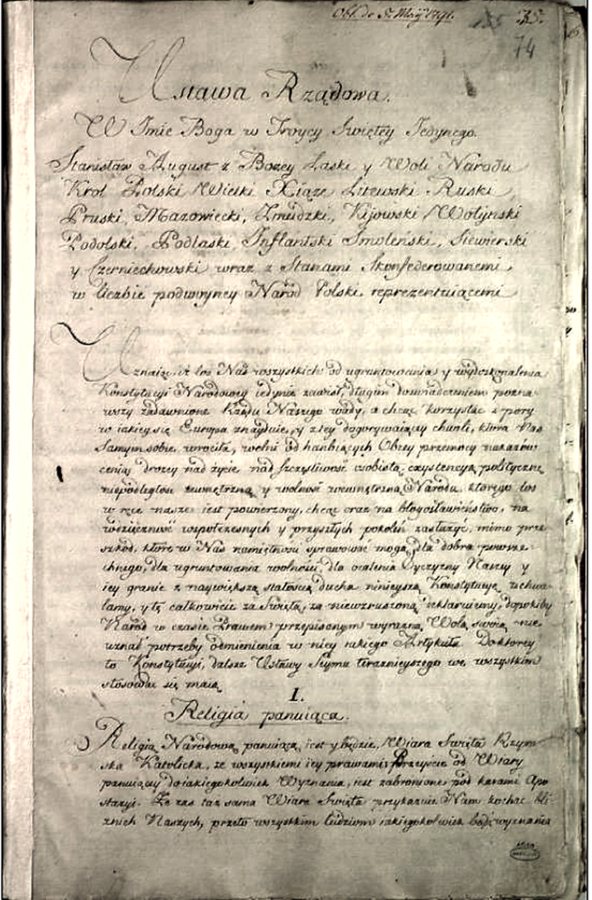
The Constitution of 3 May 1791, titled the Government Act, was a written constitution for the Polish–Lithuanian Commonwealth, adopted by the Great Sejm that met between 1788 and 1792. It aimed to make the monarchy more effective, grant political equality to townspeople and nobility, and place peasants under government protection. Described as the first modern codified constitution in Europe and the second in the world, it remained in force for less than 19 months before being declared void in 1793.

Background and causes

Constitution of 3 May 1791 by Matejko. In the foreground, King Stanisław August enters St John's Cathedral in Warsaw, where deputies will swear to uphold the Constitution. In the background stands the Royal Castle, where the Constitution has just been adopted.
King Stanisław August Poniatowski, principal author of the Constitution of 3 May 1791. A year later he acquiesced in its demise, which Constitution defenders regarded as high treason.
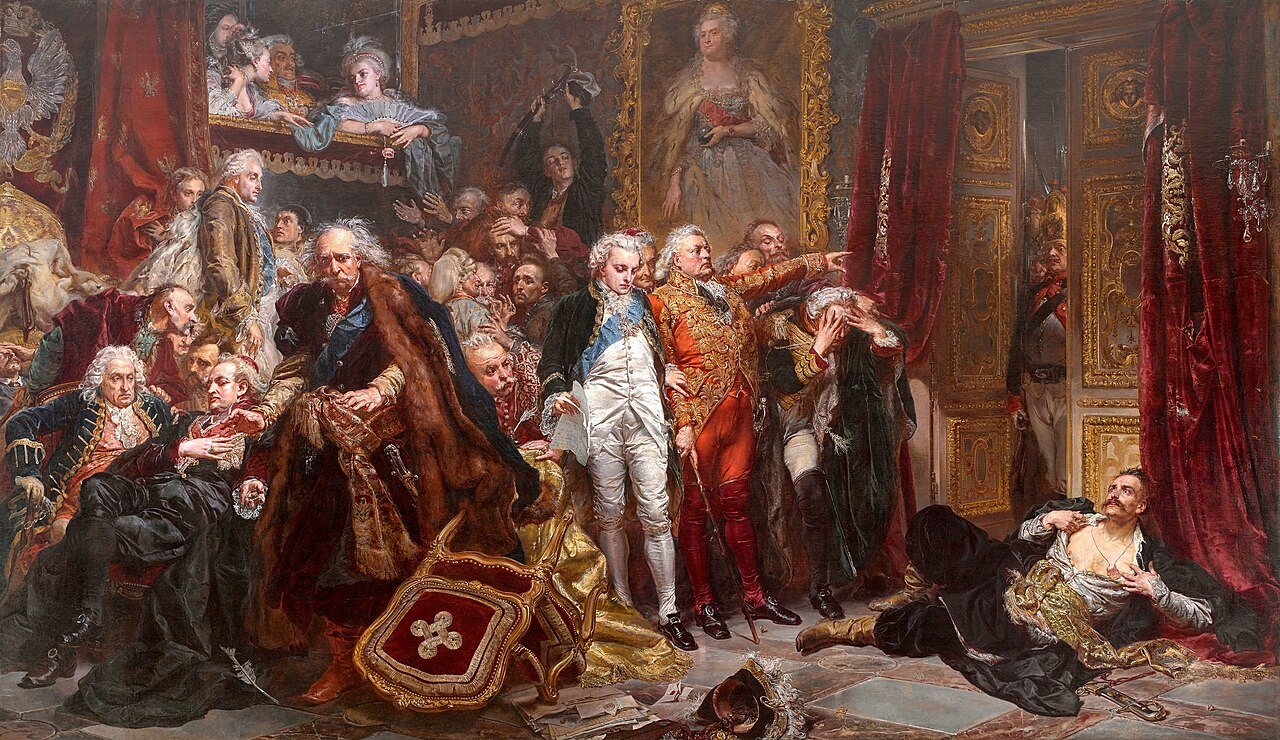
In September 1773, Tadeusz Rejtan (lower right, on the floor) tries to prevent ratification of the First Partition by barring other deputies from entering the Sejm chamber. Painting Rejtan by Matejko.
From his election, King Stanisław August Poniatowski worked to develop an executive government council. In 1775, the Partition Sejm established a Permanent Council, which suited Catherine the Great's purposes.
Senate Chamber of Warsaw's Royal Castle, where the Constitution of 3 May 1791 was adopted, painting by Kazimierz Wojniakowski, 1806.
Royal Castle Senate Chamber, reconstructed after its destruction in World War II.
Stanisław Małachowski
Hugo Kołłątaj
Hugo Kołłątaj
8 images

Polish constitutionalism dated back to the thirteenth century, but by the eighteenth century the Commonwealth had declined sharply from its earlier position as a major European power. A key cause of this decline was the liberum veto, which allowed any single Sejm deputy to nullify all legislation passed by that Sejm. Magnates and foreign powers exploited this mechanism, and the government was often paralysed. Reform efforts under the Wettin kings largely failed, and the period came to be known as Polish anarchy, while Enlightenment ideas gradually reshaped thinking within influential circles.

Reforms and legacy

Ignacy Potocki
Ignacy Potocki
Stanisław Staszic
Stanisław Staszic
Scipione Piattoli
Scipione Piattoli
3 May Constitution, printed in Warsaw, 1791
Manuscript of the 3 May Constitution in Lithuanian
English edition, London, 1791
Ruined chapel containing the cornerstone for the Temple of Divine Providence, laid on 3 May 1792 by King Stanisław August Poniatowski and his brother, Catholic Primate Michał Jerzy Poniatowski, to commemorate the Constitution. Work began only before the Russian invasion. The chapel now lies within the Warsaw University Botanical Garden.
Ruined chapel containing the cornerstone for the Temple of Divine Providence, laid on 3 May 1792 by King Stanisław August Poniatowski and his brother, Catholic Primate Michał Jerzy Poniatowski, to commemorate the Constitution. Work began only before the…
Medal commemorating the Constitution of 3 May 1791, issued that year
8 images

The reign of Stanisław August Poniatowski, who had a deeper understanding of Polish affairs and supported reform, brought early reform steps. The Constitution banned the liberum veto and sought a more effective constitutional monarchy. Neighbouring powers reacted with hostility, and Prussia joined Imperial Russia and the anti-reform Targowica Confederation to defeat the Commonwealth in 1792. The Second and Third Partitions of 1793 and 1795 ended Poland's and Lithuania's sovereign existence until 1918, yet the Constitution's legacy helped sustain national aspirations for restoration over the following 123 years.

In 36 languages

Редакція Factograf · Published October 14, 2026 · Partly based on Wikipedia, CC BY-SA 4.0 · Source article