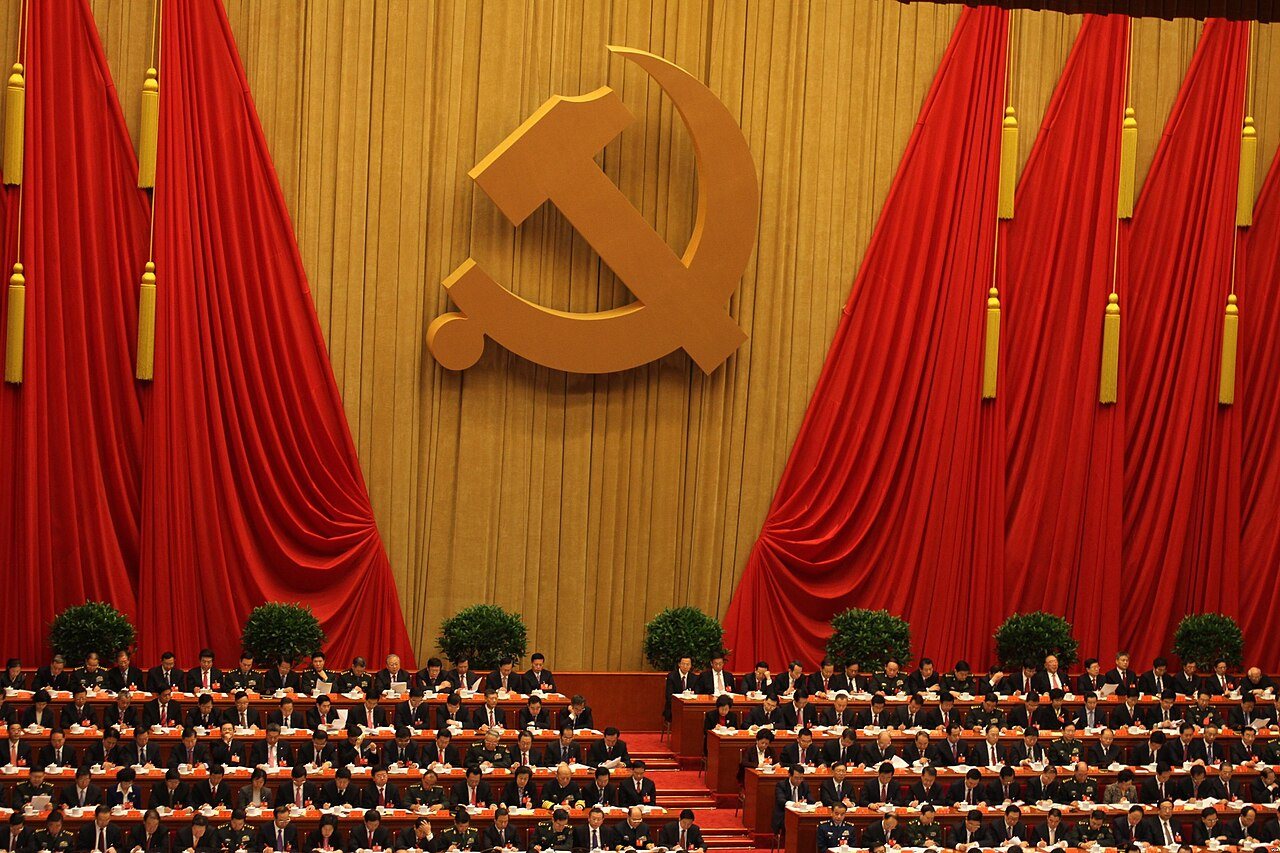
The Chinese Communist Party (CCP), formally the Communist Party of China, is the founding and sole governing party of the People's Republic of China. Founded in 1921, it won the Chinese Civil War against the Kuomintang and proclaimed the PRC in October 1949. As of 2025 it has more than 101 million members, making it the second largest political party by membership in the world. It officially adapts Marxism–Leninism to Chinese conditions, a approach it calls socialism with Chinese characteristics.
Founding and early years


The party was founded in 1921 by Chen Duxiu and Li Dazhao, who were inspired by the October Revolution and Marxist theory. Its roots lie partly in the May Fourth Movement and the study circles that followed it. The founding congress first met in Shanghai before moving to a boat on South Lake in Jiaxing after French police interrupted the meeting. Early on, the party allied with the Kuomintang, but a right-wing turn under Chiang Kai-shek and mass killings of party members led to a split and a prolonged civil war.
Rise to power


During a decade of guerrilla warfare, Mao Zedong became the party's most influential figure, and land reform policies built strong support among the rural peasantry. Support grew further during the Second Sino-Japanese War. After Japan surrendered in 1945, the party defeated the Nationalist government, and the People's Republic was established in 1949, while the Nationalist remnants retreated to Taiwan.
Organization and leadership


The party is organized on the principle of democratic centralism. The National Congress meets every five years and is the highest body, while the Central Committee and its Politburo and Standing Committee hold most of the authority between sessions. The party general secretary is the top leader and also heads the Central Military Commission, and the current leader is Xi Jinping, who has been reelected to the post twice.