factograf
EN

Protein-coding gene in humans

CACNA1G

CACNA1G
All data from the card 15
Aliases
CACNA1G, Ca(V)T.1, Cav3.1, NBR13, SCA42, calcium voltage-gated channel subunit alpha1 G, SCA42ND
External IDs
OMIM: 604065; MGI: 1201678; GeneCards: CACNA1G
Chr.
Chromosome 17 (human)
Band
17q21.33
End
50,627,474 bp
Chr.
Chromosome 11 (mouse)
Band
11|11 D
End
94,365,024 bp
BioGPS
n/a
Databases
NCBI: entry; OMA: entry
Species
Human
Entrez
8913
Ensembl
ENSG00000006283
UniProt
O43497
Location (UCSC)
Chr 17: 50.56 – 50.63 Mb

Calcium channel, voltage-dependent, T type, alpha 1G subunit, also known as CACNA1G or Cav3.1 is a protein which in humans is encoded by the CACNA1G gene. It is one of the primary targets in the pharmacology of absence seizure.

Function

Cav3.1 is a type of low-voltage-activated calcium channel, also known as "T-type" for its transient on and off. It is expressed in thalamocortical relay nucleus, and is responsible for the slow-wave sleep and absence seizure. During a slow-wave sleep, Cav3.1 is put into burst mode, and a self-sustaining synchronous cycle between cortex and thalamus is formed, sensory inputs are isolated from cortex; while awake the thalamus should instead relay sensory inputs from outside the central nervous system. The mechanism of absence seizure has a lot in common with slow-wave sleep. Therefore, a blocker that inhibits the burst mode activation of Cav3.1 is effective in treating absence seizures. Common drugs including ethosuximide, as well as trimethadione.


Interactive pathway map

Click on genes, proteins and metabolites below to link to respective Wikipedia articles.

[[File:
[[
]]
[[
]]
[[
]]
[[
]]
[[
]]
[[
]]
[[
]]
[[
]]
[[
]]
[[
]]
[[
]]
[[
]]
[[
]]
[[
]]
]]
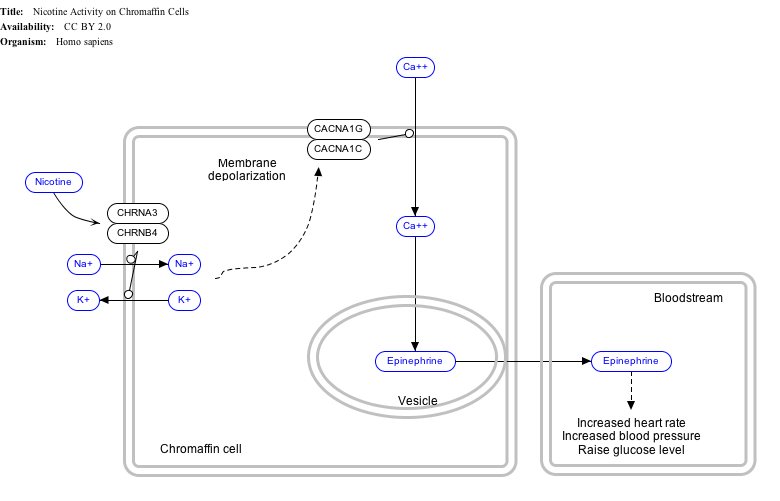
Nicotine Activity on Chromaffin Cells edit

Read next

In 2 languages

Text from Wikipedia, CC BY-SA 4.0 · Source article