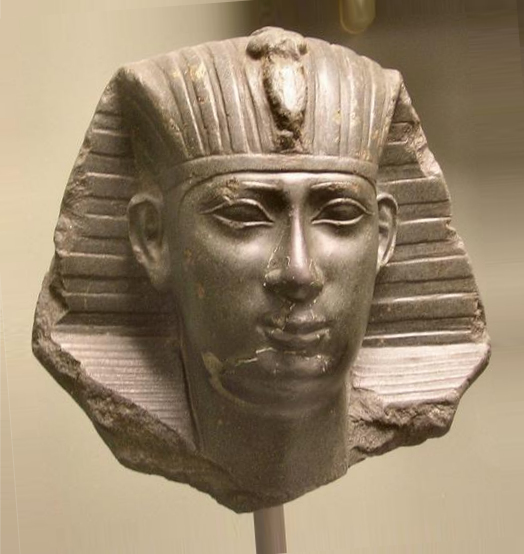
The Twenty-sixth Dynasty of Egypt (notated Dynasty XXVI, alternatively 26th Dynasty or Dynasty 26) was the last native dynasty of ancient Egypt before the Persian conquest in 525 BC (although other brief periods of rule by Egyptians followed). The dynasty's reign (664–525 BC) is also called the Saite Period after the city of Sais, where its pharaohs had their capital, and marks the beginning of the Late Period of ancient Egypt.
History

This dynasty traced its origins to the Twenty-fourth Dynasty. Psamtik I was probably a descendant of Bakenranef. However, other sources describe him as of Libyan descent.
Following the Neo-Assyrian conquest of Egypt during the reigns of Taharqa and Tantamani, and the subsequent collapse of the Napata-based Twenty-fifth Dynasty of Egypt, Psamtik I was recognized as sole king over all of Egypt. Psamtik formed alliances with King Gyges of Lydia, who sent him mercenaries from Caria and ancient Greece that Psamtik used to unify all of Egypt under his rule.
With the sack of Nineveh in 612 BC and the Fall of the Neo-Assyrian Empire, both Psamtik and his successors attempted to reassert Egyptian power in the Near East but were driven back by the Neo-Babylonian Empire under Nebuchadnezzar II. With the help of Greek mercenaries, Pharaoh Apries was able to hold back Babylonian attempts to conquer Egypt, although Apries was later deposed by Amasis II in 570 BC, who became the next Pharaoh of Egypt.
In Amasis' fourth year, around 568–567 BC, Egypt was invaded by the Babylonians, under the leadership of Nebuchadnezzar II. This assault was recorded by a fragmentary Babylonian inscription, with the modern designation BM 33041; the inscription from that year records the word "Egypt" as well as possible traces of the name "Amasis". A stele of Amasis from the 4th year of his reign in 567 BC, also fragmentary, may also describe a combined naval and land attack by the Babylonians. Recent evidence suggests that the Babylonians were initially successful during the invasion and gained a foothold in Egypt, but they were repelled by Amasis' forces. It is believed that this forced Nebuchadnezzar II to retire plans to conquer Egypt. (However, some have suggested that Nebuchadnezzar came to defeat Apries, with the combined forces of Amasis and Nebuchadnezzar managing to kill him, securing Amasis' throne, though as vassal king.)
The Persians would eventually invade Egypt in 525 BCE when Emperor Cambyses II captured and later executed Psamtik III in the First Achaemenid conquest of Egypt, marking the end of the last native dynasty of Egypt. Cambyses founded the First Egyptian Satrapy, a territory of the Achaemenid Empire, and was crowned the first Pharaoh of the Dynasty XXVII.
Archaeology
In May 2020, an Egyptian-Spanish archaeological mission headed by Esther Ponce revealed a unique cemetery, which consists of one room built with glazed limestone dating back to the 26th Dynasty (also known as the El-Sawi era) at the site of ancient Oxyrhynchus. Archaeologists also uncovered bronze coins, clay seals, Roman tombstones and small crosses. On October 3, 2020, Egypt unveiled 59 coffins of priests and clerks from the 26th dynasty, dating to nearly 2,500 years ago.
Art


Pharaohs of the 26th Dynasty


The 26th Dynasty may be related to the 24th Dynasty. Manetho begins the dynasty with:
- Ammeris the Nubian (= ? Ammeris), 12 (or 18) years
- Stephinates (= ? Tefnakht II), 7 years
- Nechepsos (= ? Nekauba), 6 years
- Necho (= ? Necho I), 8 years.
When the Nubian King Shabaka defeated Bakenranef, son of Tefnakht, he likely installed a Nubian commander as governor at Sais. This may be the man named Ammeris. Stephinates may be a descendant of Bakenrenef. He is sometimes referred to as Tefnakht II in the literature. Nechepsos has been identified with a local king named Nekauba (678–672 BC). Manetho's Necho is King Necho I (672–664 BC); Manetho gives his reign as 8 years. Necho was killed during a conflict with the Nubian king Tantamani. Psamtik I fled to Nineveh – capital of the Neo-Assyrian Empire – and returned to Egypt when Ashurbanipal defeated Tantamani and drove him back south. Scholars now start the 26th Dynasty with the reign of Psamtik I.
Sextus Julius Africanus states in his often accurate version of Manetho's Epitome that the dynasty numbered nine pharaohs, beginning with a "Stephinates" (Tefnakht II) and ending with Psamtik III. Africanus also notes that Psamtik I and Necho I ruled for 54 and 8 years respectively.
| Pharaoh | Image | Prenomen (Throne name) | Horus-name | Reign | Burial | Consort(s) | Comments |
|---|---|---|---|---|---|---|---|
| Psamtik I Psammetichus I |
Wahibre | Aaib | 664–610 BC | Sais | Mehytenweskhet | Reunified Egypt and ended the Kushite control of Upper Egypt. Manetho gives his reign as 54 years. | |
| Necho II | Wehemibre | Siaib | 610–595 BC | Khedebneithirbinet I | Necho II is the Pharaoh most likely mentioned in several books of the Bible. | ||
| Psamtik II Psammetichus II |
Neferibre | Menekhib | 595–589 BC | Takhuit | |||
| Wahibre Haaibre Apries) |
Haaibre | 589–570 BC | Wahib | Overthrown and forced into exile by Amasis II. Returned to Egypt at the head of a Babylonian army, but was defeated and likely killed. Manetho gives his reign as 19 years. | |||
| Amasis II Ahmose II |
Khnem-ib-re | Semenmaat | 570–526 BC | Sais | Tentkheta Nakhtubasterau |
Herodotus claims that when Cambyses II invaded Egypt, realizing he was not able to exact revenge for Amasis's previous misdeeds and trickery, he exhumed his body, desecrated it and burned what remained of the mummy. | |
| Psamtik III Psammetichus III |
Ankhkaenre | (unknown) | 526–525 BC | Ruled for only 6 months, according to Herodotus, before a Persian invasion led by Cambyses II conquered Egypt and captured Psamtik III. Committed suicide in Persian captivity. |


