In computer science, locality-sensitive hashing (LSH) is a fuzzy hashing technique that hashes similar input items into the same "buckets" with high probability. The number of buckets is much smaller than the universe of possible input items. Since similar items end up in the same buckets, this technique can be used for data clustering and nearest neighbor search. It differs from conventional hashing techniques in that hash collisions are maximized, not minimized. Alternatively, the technique can be seen as a way to reduce the dimensionality of high-dimensional data; high-dimensional input items can be reduced to low-dimensional versions while preserving relative distances between items.
Hashing-based approximate nearest-neighbor search algorithms generally use one of two main categories of hashing methods: either data-independent methods, such as locality-sensitive hashing (LSH); or data-dependent methods, such as locality-preserving hashing (LPH).
Locality-preserving hashing was initially devised as a way to facilitate data pipelining in implementations of massively parallel algorithms that use randomized routing and universal hashing to reduce memory contention and network congestion.
Definitions
A finite family 

- a metric space
,
- a threshold
,
- an approximation factor
,
- and probabilities

if it satisfies the following condition. For any two points 

- If
, then
(i.e., a and b collide) with probability at least
,
- If
, then
.
Such a family 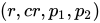
LSH with respect to a similarity measure
Alternatively it is possible to define an LSH family on a universe of items U endowed with a similarity function ![{\displaystyle \phi \colon U\times U\to [0,1]}](https://wikimedia.org/api/rest_v1/media/math/render/svg/5687d93ac393d6903b3fdf0d3cc173da5792313e)

![{\displaystyle Pr[h(a)=h(b)]=\phi (a,b)}](https://wikimedia.org/api/rest_v1/media/math/render/svg/abd8774392b325d2241014de6e8547f5b376ae19)

Amplification
Given a 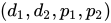

To create an AND-construction, we define a new family 


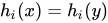

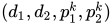
To create an OR-construction, we define a new family 
Applications
LSH has been applied to several problem domains, including:
- Near-duplicate detection
- Hierarchical clustering
- Genome-wide association study
- Image similarity identification
- Gene expression similarity identification
- Audio similarity identification
- Nearest neighbor search
- Audio fingerprint
- Digital video fingerprinting
- Shared memory organization in parallel computing
- Physical data organization in database management systems
- Training fully connected neural networks
- Computer security
- Machine learning
Methods
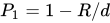
Bit sampling for Hamming distance
One of the easiest ways to construct an LSH family is by bit sampling. This approach works for the Hamming distance over d-dimensional vectors 







Min-wise independent permutations
Suppose U is composed of subsets of some ground set of enumerable items S and the similarity function of interest is the Jaccard index J. If π is a permutation on the indices of S, for 
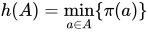
Define the function family H to be the set of all such functions and let D be the uniform distribution. Given two sets 
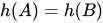


![{\displaystyle Pr[h(A)=h(B)]=J(A,B)\,}](https://wikimedia.org/api/rest_v1/media/math/render/svg/a54e5e0058c034a898dcbf92737b7db0feff4a15)

Because the symmetric group on n elements has size n!, choosing a truly random permutation from the full symmetric group is infeasible for even moderately sized n. Because of this fact, there has been significant work on finding a family of permutations that is "min-wise independent" — a permutation family for which each element of the domain has equal probability of being the minimum under a randomly chosen π. It has been established that a min-wise independent family of permutations is at least of size 
Because min-wise independent families are too big for practical applications, two variant notions of min-wise independence are introduced: restricted min-wise independent permutations families, and approximate min-wise independent families. Restricted min-wise independence is the min-wise independence property restricted to certain sets of cardinality at most k. Approximate min-wise independence differs from the property by at most a fixed ε.
Open source methods
Nilsimsa Hash
Nilsimsa is a locality-sensitive hashing algorithm used in anti-spam efforts. The goal of Nilsimsa is to generate a hash digest of an email message such that the digests of two similar messages are similar to each other. The paper suggests that the Nilsimsa satisfies three requirements:
- The digest identifying each message should not vary significantly for changes that can be produced automatically.
- The encoding must be robust against intentional attacks.
- The encoding should support an extremely low risk of false positives.
Testing performed in the paper on a range of file types identified the Nilsimsa hash as having a significantly higher false positive rate when compared to other similarity digest schemes such as TLSH, Ssdeep and Sdhash.
TLSH
TLSH is locality-sensitive hashing algorithm designed for a range of security and digital forensic applications. The goal of TLSH is to generate hash digests for messages such that low distances between digests indicate that their corresponding messages are likely to be similar.
An implementation of TLSH is available as open-source software.
Random projection
The random projection method of LSH due to Moses Charikar called SimHash (also sometimes called arccos) uses an approximation of the cosine distance between vectors. The technique was used to approximate the NP-complete max-cut problem.
The basic idea of this technique is to choose a random hyperplane (defined by a normal unit vector r) at the outset and use the hyperplane to hash input vectors.
Given an input vector v and a hyperplane defined by r, we let 


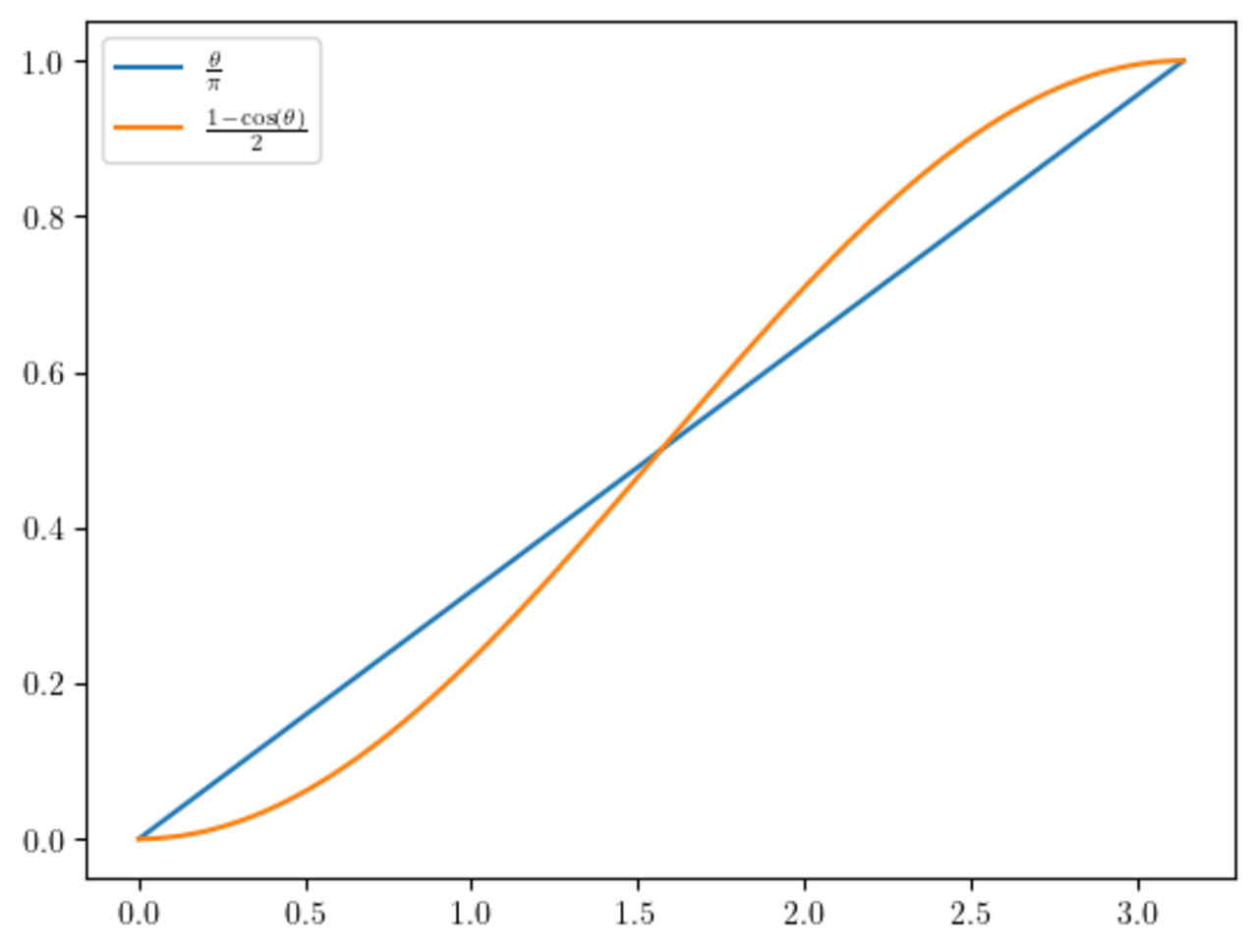
For two vectors u,v with angle 
![{\displaystyle Pr[h(u)=h(v)]=1-{\frac {\theta (u,v)}{\pi }}.}](https://wikimedia.org/api/rest_v1/media/math/render/svg/c16665c9fa384120f55b44ac7197d147ed9652b8)
Since the ratio between 

![{\displaystyle \theta (u,v)\in [0,\pi]}](https://wikimedia.org/api/rest_v1/media/math/render/svg/61609a42522867b54976fd386171f22fb657549d)
Stable distributions
The hash function



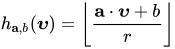
Other construction methods for hash functions have been proposed to better fit the data. In particular k-means hash functions are better in practice than projection-based hash functions, but without any theoretical guarantee.
Semantic hashing
Semantic hashing is a technique that attempts to map input items to addresses such that closer inputs have higher semantic similarity. The hashcodes are found via training of an artificial neural network or graphical model.
Algorithm for nearest neighbor search
One of the main applications of LSH is to provide a method for efficient approximate nearest neighbor search algorithms. Consider an LSH family
In the first step, we define a new family ![{\displaystyle g(p)=[h_{1}(p),\ldots,h_{k}(p)]}](https://wikimedia.org/api/rest_v1/media/math/render/svg/a1bae3b75c37b58d8cf55999768bd3840f836c1a)
In the preprocessing step we hash all n d-dimensional points from the data set S into each of the L hash tables. Given that the resulting hash tables have only n non-zero entries, one can reduce the amount of memory used per each hash table to 
Given a query point q, the algorithm iterates over the L hash functions g. For each g considered, it retrieves the data points that are hashed into the same bucket as q. The process is stopped as soon as a point within distance cR from q is found.
Given the parameters k and L, the algorithm has the following performance guarantees:
- preprocessing time:
, where t is the time to evaluate a function
on an input point p;
- space:
, plus the space for storing data points;
- query time:
;
- the algorithm succeeds in finding a point within distance cR from q (if there exists a point within distance R) with probability at least
;
For a fixed approximation ratio 
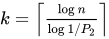


- preprocessing time:
;
- space:
, plus the space for storing data points;
- query time:
;
Finding nearest neighbor without fixed dimensionality
To generalize the above algorithm without radius R being fixed, we can take the algorithm and do a sort of binary search over R. It has been shown that there is a data structure for the approximate nearest neighbor with the following performance guarantees:
- space:
;
- query time:
;
- the algorithm succeeds in finding the nearest neighbor with probability at least
;
Improvements
When t is large, it is possible to reduce the hashing time from 
- query time:
;
- space:
;
It is also sometimes the case that the factor 
